England
Disabled Facilities Grant
Up to £30,000. "Some councils may give more."
Your council's housing or adult social care team.
England · Scotland · Wales · Northern Ireland
Stairlift grants in the UK come from your council, or from the Housing Executive in Northern Ireland. There is no national scheme to apply to, and each nation has its own rules. Choose yours to see what the grant can pay and who to ask, then get a stair lift quote if you want one. You don't have to buy anything.
Where is the home? Choose the nation.
England: Disabled Facilities Grant
Your council's Disabled Facilities Grant can pay up to £30,000 towards a stair lift. It is usually means-tested, and the council must decide within 6 months of a full application.
Source: GOV.UK: Disabled Facilities Grants, what you'll get (checked 13 Nov 2026)
Scotland: Scheme of Assistance (mandatory grant)
Scotland has no Disabled Facilities Grant. Where your council finds a permanent adaptation essential it must pay a grant of at least 80% of the approved cost, and 100% on certain benefits. Some areas lend a stair lift as equipment instead.
Source: gov.scot: funding adaptations to the home, a guide for homeowners (checked 13 Nov 2026)
Wales: Disabled Facilities Grant, with ENABLE funding
Your council's Disabled Facilities Grant can pay up to £36,000. Since April 2021 most Welsh councils have not means-tested a grant for a stair lift, so check with yours.
Sources: Disabled Facilities Grants (Maximum Amounts and Additional Purposes) (Wales) Order 2008 (checked 12 Nov 2026); GOV.WALES: written statement on removing the means test for small and medium grants (checked 13 Nov 2026)
Northern Ireland: Disabled Facilities Grant
The Housing Executive's Disabled Facilities Grant can pay up to £35,000, and up to £70,000 in some cases. It is means-tested and starts with your Health and Social Care Trust's occupational therapist, not with a form.
Source: nidirect: Disabled Facilities Grants (checked 13 Nov 2026)
Tell us where the stair lift is for and how you expect to pay. We reply by email.
What to expect from a council grant
Sources: GOV.UK, what you'll get, GOV.UK, how to apply, the 1996 Act, section 34, nidirect and GOV.WALES, all checked 13 Nov 2026.
Don't order, sign or start before approval
GOV.UK says: You might not get any grant if you start work on your property before the council approves your application.
That covers ordering and fitting a stair lift.
GOV.UK, eligibility (checked 13 Nov 2026)
Sources: GOV.UK: Disabled Facilities Grants, what you'll get (checked 13 Nov 2026); GOV.UK: Disabled Facilities Grants, eligibility (checked 13 Nov 2026); nidirect: Disabled Facilities Grants (checked 13 Nov 2026)
Four nations, four sets of rules. The scheme, the limit and the first person to ask all change at the border.
Disabled Facilities Grant
Up to £30,000. "Some councils may give more."
Your council's housing or adult social care team.
Scheme of Assistance (mandatory grant)
No upper limit on the cost of the work. The council checks that the cost is reasonable.
Your council's social work team, which arranges a care needs assessment.
Disabled Facilities Grant, with ENABLE funding
Up to £36,000, set by a 2008 order.
Home owners: the local authority. Private, council and housing association tenants: the landlord.
Disabled Facilities Grant
Up to £35,000; "in some cases" up to a maximum of £70,000. GOV.UK's table still shows £25,000.
Your local Health and Social Care Trust; your GP or social worker can also start it.
Most pages about paying for a stair lift describe England and stop. That leaves three nations with the wrong answer. Scotland has no Disabled Facilities Grant at all: its councils pay a share of the approved cost instead, and some areas lend a stair lift as equipment. Most Welsh councils stopped means-testing stair lift grants in April 2021. And Northern Ireland's limit is £35,000, not the £25,000 that GOV.UK's own table still shows.
Each nation has its own page here: England, Scotland, Wales and Northern Ireland. The same facts sit side by side in the rules table.
Sources: GOV.UK: Disabled Facilities Grants, what you'll get (checked 13 Nov 2026); gov.scot: funding adaptations to the home, a guide for homeowners (checked 13 Nov 2026); GOV.WALES: written statement on removing the means test for small and medium grants (checked 13 Nov 2026); nidirect: Disabled Facilities Grants (checked 13 Nov 2026)
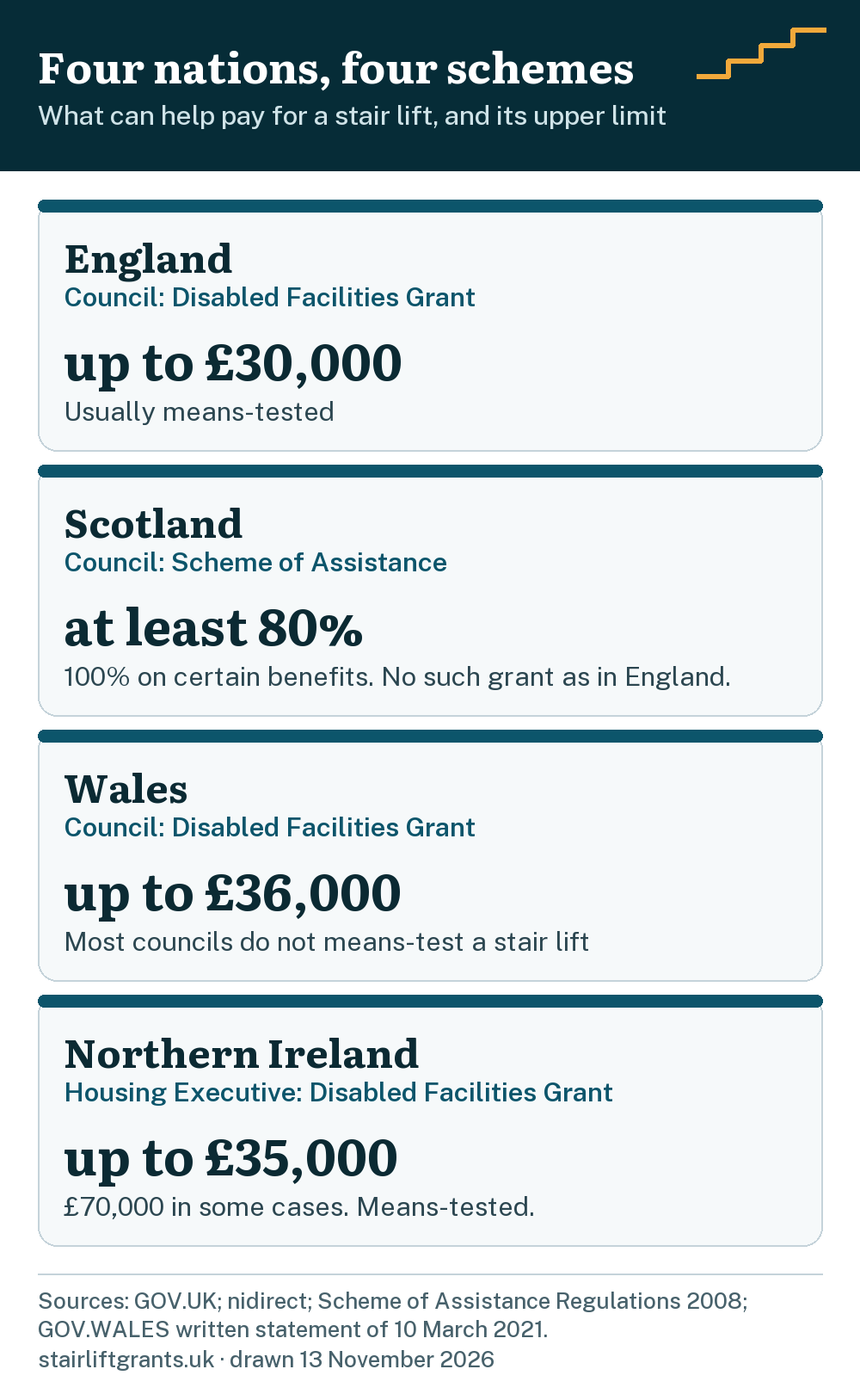
One row per nation: who runs the scheme, the upper limit, whether there is a means test and who to ask first.
| Nation | Scheme and who runs it | Upper limit | Means test | Who to ask first |
|---|---|---|---|---|
| England | Disabled Facilities Grant Your local council (the housing authority) | Up to £30,000. "Some councils may give more." | Usually yes: the amount "usually depends on" income and savings over £6,000. Not for a disabled child under 18, not for a landlord's application, and some councils waive it for stair lifts. | Your council's housing or adult social care team. |
| Scotland | Scheme of Assistance (mandatory grant) Your local council, starting with its social work team | No upper limit on the cost of the work. The council checks that the cost is reasonable. | No test for the 80% grant: it "does not depend on your income". 100% on five listed benefits. A council's top-up above 80% is usually means-tested. | Your council's social work team, which arranges a care needs assessment. |
| Wales | Disabled Facilities Grant, with ENABLE funding Your local council; your landlord first if you rent | Up to £36,000, set by a 2008 order. | Mostly no for a stair lift: since April 2021 it has been a condition of Welsh Government funding that councils do not means-test small and medium grants. Two councils still tested medium adaptations in 2023/24 and 2024/25. | Home owners: the local authority. Private, council and housing association tenants: the landlord. |
| Northern Ireland | Disabled Facilities Grant The Northern Ireland Housing Executive, on an occupational therapist's recommendation | Up to £35,000; "in some cases" up to a maximum of £70,000. GOV.UK's table still shows £25,000. | Yes: "A calculation will be made to decide if you have to make a contribution." | Your local Health and Social Care Trust; your GP or social worker can also start it. |
The full table, with the assessment, the decision time and every source, is on stair lift grant rules by nation. Checked 13 Nov 2026.
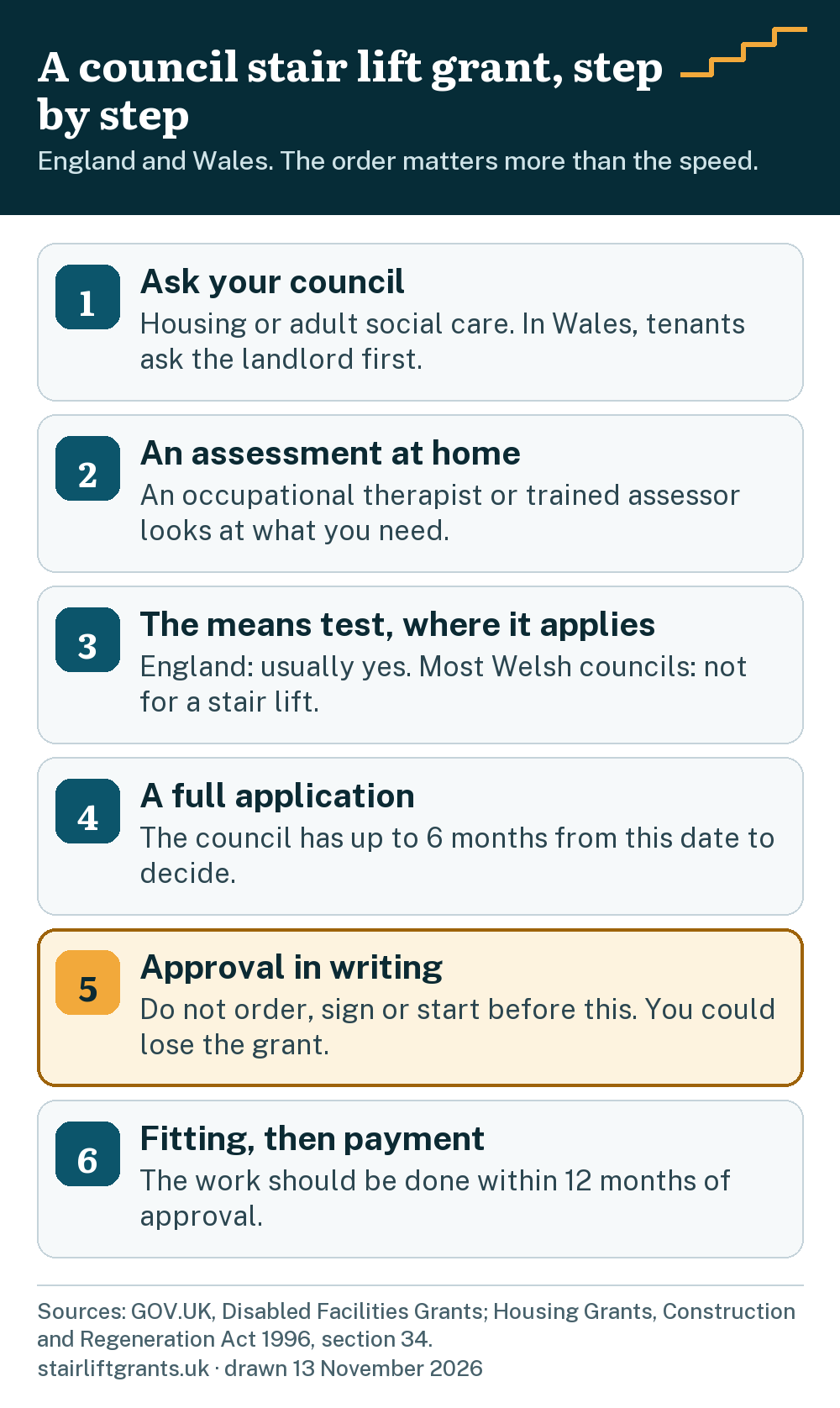
This is the route in England and Wales. The order matters more than the speed.
Housing or adult social care. You can ask for a home assessment without knowing which scheme applies.
An occupational therapist or trained assessor visits and works out what you need. A stair lift may be it, or they may suggest something else.
England usually looks at income and savings. Most Welsh councils do not for a stair lift.
From this date the council has up to 6 months to decide.
Do not order, sign or start before it arrives.
The work should be done within 12 months of approval. The council may pay the contractor directly.
Sources: GOV.UK: Disabled Facilities Grants, how to apply (checked 13 Nov 2026); GOV.UK: Disabled Facilities Grants, what you'll get (checked 13 Nov 2026); Housing Grants, Construction and Regeneration Act 1996, section 34 (checked 13 Nov 2026)
How to fill in the forms and what the means test asks is a subject of its own. This site covers which scheme applies and what it can pay.
Nobody publishes the share of stair lift grant applications that succeed, so this site gives no odds in figures. What the official sources do say tells you enough to judge whether asking is worth it.
Sources: GOV.UK: Disabled Facilities Grant delivery, guidance for local authorities in England (checked 13 Nov 2026); GOV.UK: Disabled Facilities Grants, what you'll get (checked 13 Nov 2026); GOV.UK: government response on how Disabled Facilities Grant funding is shared between councils (checked 12 Nov 2026); Housing Grants, Construction and Regeneration Act 1996, section 34 (checked 13 Nov 2026)
Each has its own page, with the answer in the first lines and the sources at the foot.
VAT relief is separate from any grant and is not means-tested. If you are disabled or have a long-term illness, you are not charged VAT on a stair lift bought for your own use, and the fitting is covered too. GOV.UK is blunt about age: "You do not qualify if you're elderly but not disabled". A person aged 60 or over who is not disabled pays VAT at 5% instead, and only when the same firm supplies and installs the stair lift in their home.
Sources: GOV.UK: VAT relief for disabled people (checked 13 Nov 2026); GOV.UK: VAT on mobility aids (checked 13 Nov 2026)
A grant is slow by design and it will not suit everyone. If you are refused, face a large contribution or cannot wait, these are the other ways people cut the cost.
Sources: NHS: home adaptations (checked 13 Nov 2026); GOV.UK: Disabled Facilities Grant delivery, guidance for local authorities in England (checked 13 Nov 2026); GOV.UK: VAT relief for disabled people (checked 13 Nov 2026)
Whichever way you pay, you don't have to buy anything from an enquiry here.
It depends on the nation. In England the amount usually depends on income and on savings over £6,000, though some councils have dropped the test for stair lifts. In Wales most councils no longer means-test a stair lift grant. In Northern Ireland the Housing Executive works out whether you pay a contribution. In Scotland the basic grant of 80% does not depend on income.
The limits are ceilings, not offers. A Disabled Facilities Grant can pay up to £30,000 in England, up to £36,000 in Wales and up to £35,000 in Northern Ireland (£70,000 in some cases). Scotland pays a share of the approved cost: at least 80%. A stair lift costs far less than those limits, so what matters is the means test and the council's decision, not the ceiling.
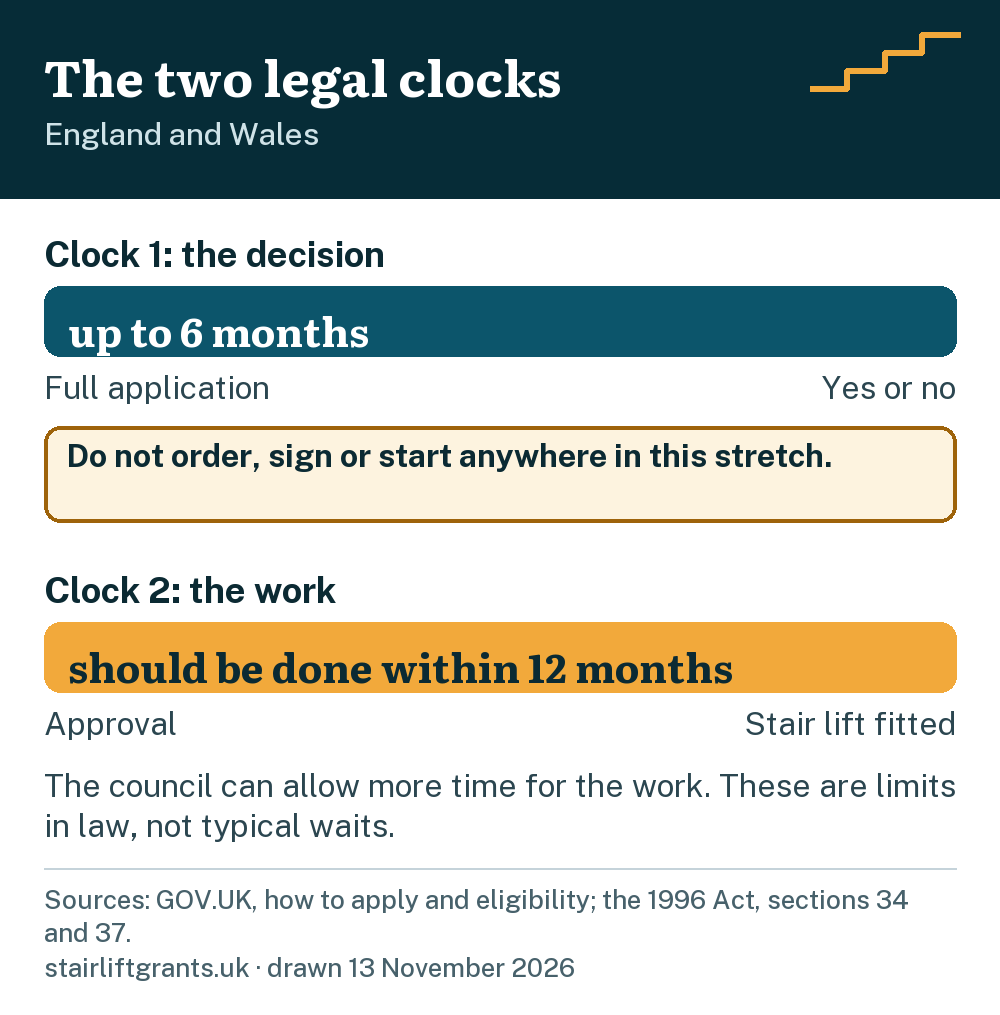
In England and Wales the council must give its decision no later than six months after the date of a full application, and the work should be done within 12 months of approval. Those are legal limits, not typical waits. No official figure for the usual wait was found, so this site does not quote one.
No. GOV.UK says you might not get any grant if you start work before the council approves your application. Ordering or fitting a stair lift counts. Wait for the approval in writing.
In England, your council's housing or adult social care team. In Scotland, the council's social work team. In Wales, the council if you own your home and your landlord if you rent. In Northern Ireland, your Health and Social Care Trust, whose occupational therapist starts the process.
No. Stairlift Grants is published by SEO-DONS LTD, a private company. It cannot take, assess or decide a grant application. It explains the rules from official sources and takes stair lift quote enquiries, which we answer by email.
Stairlift Grants is published by SEO-DONS LTD, a company registered in England and Wales. It is not a council, a government body, an NHS service or a stair lift company. It cannot apply for a grant, assess anyone or decide anything. What it does is set out the rules from official pages, with a link and a date beside every figure, and take stair lift quote enquiries, which we answer by email.
Page last reviewed 13 November 2026. Read about this site and how the facts are checked.
Tell us where the stair lift is for and how you expect to pay. Your details go to SEO Dons Ltd, the company that publishes this website, and we reply by email about a quote and the grant route that matches what you have told us. You don't have to buy anything.
You don't have to buy anything.
What to expect from a council grant
Sources: GOV.UK, what you'll get, GOV.UK, how to apply, the 1996 Act, section 34, nidirect and GOV.WALES, all checked 13 Nov 2026.
Don't order, sign or start before approval
GOV.UK says: You might not get any grant if you start work on your property before the council approves your application.
That covers ordering and fitting a stair lift.
GOV.UK, eligibility (checked 13 Nov 2026)