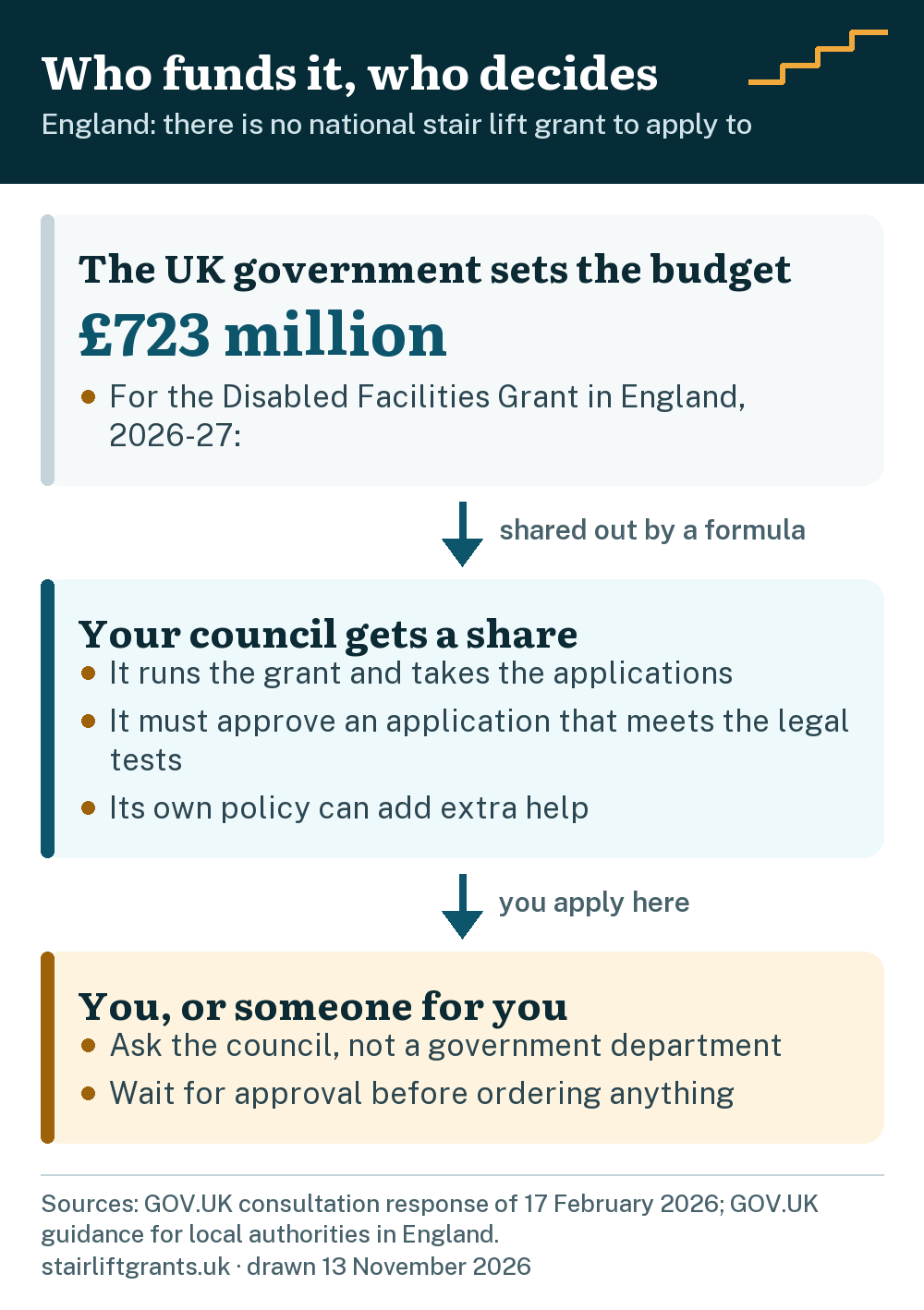
People search for a "government grant" because the money is public and the rules are set in law, so it feels like the government's. Both of those things are true. What is not true is that there is a government office, form or helpline for stair lifts. Every route on this site ends at a local body that takes the application and decides it.
How the money flows in England
The Disabled Facilities Grant is paid for by central government and run by councils. The government confirmed £723 million for the grant in England in 2026-27, after £761 million in 2025-26. It reaches councils through the Better Care Fund, and from 2026-27 it is shared out by a new formula based on need. The formula comes with protection: no council gets less in 2026-27 than it received in June 2025, and the protection steps down over the two years after. Source: GOV.UK: government response on how Disabled Facilities Grant funding is shared between councils (checked 12 Nov 2026)
From there it is the council's decision. The guidance for councils in England describes a statutory duty "to provide adaptations for eligible disabled people" and says "the administration of DFGs is the responsibility of the local housing authority, through all stages from initial enquiry (or referral) to post-completion". Councils can also add their own money under a published housing assistance policy, which is why the help differs from one council to the next, as council grants for stairlifts shows with three councils' own rules. Source: GOV.UK: Disabled Facilities Grant delivery, guidance for local authorities in England (checked 13 Nov 2026)
Wales, Scotland and Northern Ireland
Each devolved government funds its own routes, and in none of them do you apply to the government itself.
- Wales. Councils run the Disabled Facilities Grant, and the Welsh Government adds its ENABLE grant to councils. When it removed the means test for small and medium grants in 2021, it raised ENABLE "by £400,000, to £4.4 million" for that year. Housing association tenants have the Physical Adaptations Grant, which the association claims from the Welsh Government after the work, and which can pay for stair lifts.
- Scotland. Councils help home owners under the Housing (Scotland) Act 2006. For housing association tenants, the Scottish Government's leaflet says "your housing association receives funding from the Scottish Government to pay for this work".
- Northern Ireland. The grant is run by the Housing Executive, on the recommendation of an occupational therapist from your Health and Social Care Trust.
Sources: GOV.WALES: written statement on removing the means test for small and medium grants (checked 13 Nov 2026); GOV.WALES: adapt your home if you live in social housing (checked 13 Nov 2026); gov.scot: equipment and adaptations, guidance on provision (statutory responsibilities) (checked 13 Nov 2026); gov.scot: funding adaptations to the home, a guide for housing association tenants (checked 13 Nov 2026); nidirect: Disabled Facilities Grants (checked 13 Nov 2026)
The one help set nationally: VAT relief
If there is a "government" help with the cost of a stair lift that works the same from Cornwall to Caithness, it is VAT relief. It is set in the VAT Act 1994, applies across the UK, is not means-tested and does not depend on any grant. You do not apply to anyone: the supplier applies it when you confirm in writing that you qualify.
- If you are disabled or have a long-term illness, "you will not be charged VAT on products designed or adapted for your own personal or domestic use", and GOV.UK's examples include stair lifts. The fitting and later repairs are covered too.
- If you are aged 60 or over and not disabled, you pay VAT at 5% on a stair lift when the same firm supplies and installs it in your home.
"You do not qualify if you're elderly but not disabled" for the first of those, so age on its own brings only the 5% rate. The full rules are on stairlift VAT relief. Sources: GOV.UK: VAT relief for disabled people (checked 13 Nov 2026); GOV.UK: VAT on mobility aids (checked 13 Nov 2026); Value Added Tax Act 1994, Schedule 8, Group 12 (checked 12 Nov 2026); Value Added Tax Act 1994, Schedule 7A, Group 10 (checked 12 Nov 2026)
Offers to be wary of
Because there is no national scheme, anything that presents itself as one deserves a second look. If a company offers to get you a government grant for a stair lift, remember that the grant is the council's and the council takes the application. A firm can give you a quote, and the council may ask for estimates from contractors, but no firm can approve a grant.
The same caution applies to the order of things. Whoever you speak to first, do not sign or order before the council's approval arrives in writing: GOV.UK warns that "you might not get any grant if you start work on your property before the council approves your application". Sources: GOV.UK: Disabled Facilities Grants, eligibility (checked 13 Nov 2026); GOV.UK: Disabled Facilities Grant delivery, guidance for local authorities in England (checked 13 Nov 2026)
Some people expect the health service to provide a stair lift instead. The health side has a real part, mainly the assessment, but the grant itself is still the council's: stairlifts and the NHS explains who does what. And for what the grant pays for once a stair lift is agreed, from the fitting to a warranty, read the Disabled Facilities Grant for a stairlift.