"Council grant" is how most people describe the help, and it is accurate: the money that pays for a stair lift in England and Wales goes through the council, and the council decides. In Scotland the council decides too, under a different scheme, set out on stairlift grants in Scotland. In Northern Ireland the Housing Executive takes the council's place. This page is about the councils of England and Wales.
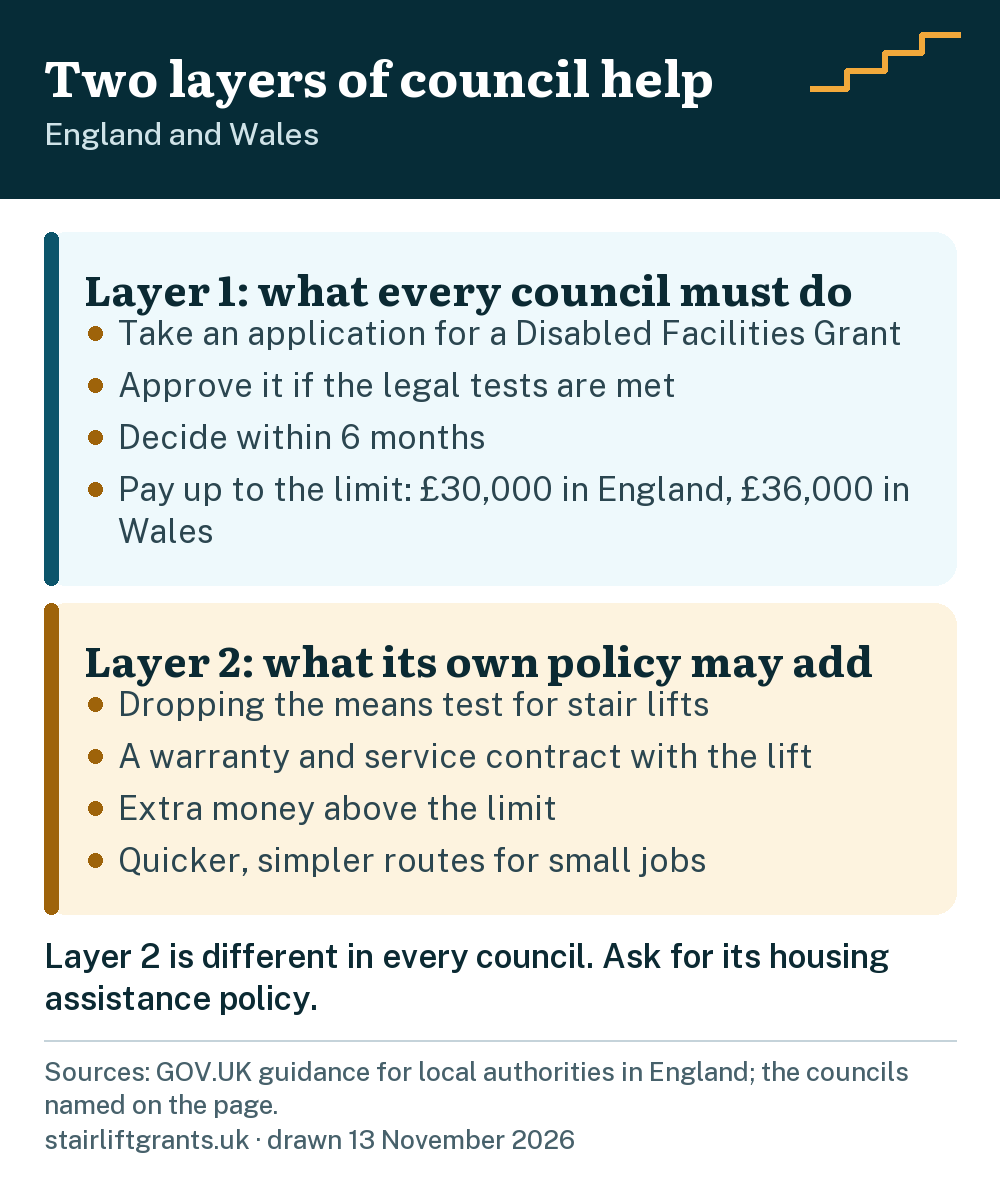
Layer one: what every council must do
The Disabled Facilities Grant is a duty, not a favour. The guidance for councils in England says local housing authorities "have a statutory duty under the 1996 Act to provide adaptations for eligible disabled people", and that they "still have a statutory duty to approve DFG applications which meet the statutory requirements", whatever else their local policy says.
- The limit: up to £30,000 in England and £36,000 in Wales. "Some councils may give more."
- The tests: the work must be "necessary and appropriate" for the disabled person and "reasonable and can be done" in the home.
- The means test: in England the amount "usually depends on" income and savings over £6,000.
- The clock: the council must decide "not later than six months after the date of the application".
- The order: "You might not get any grant if you start work on your property before the council approves your application."
A stair lift is one of the grant's named examples, and the guidance says help with lifts is "normally provided through the DFG". What the grant can include on a stair lift job, from the fitting to a warranty, is set out on the Disabled Facilities Grant for a stairlift. Sources: GOV.UK: Disabled Facilities Grant delivery, guidance for local authorities in England (checked 13 Nov 2026); GOV.UK: Disabled Facilities Grants, what you'll get (checked 13 Nov 2026); GOV.UK: Disabled Facilities Grants, eligibility (checked 13 Nov 2026); Housing Grants, Construction and Regeneration Act 1996, section 34 (checked 13 Nov 2026)
Layer two: what a council's own policy may add
On top of the duty, councils have wider powers. Under the Regulatory Reform (Housing Assistance) (England and Wales) Order 2002, a council can give other help with adaptations, but only "in accordance with a published Housing Assistance Policy". The guidance's own examples of what such a policy can do include:
- "not requiring means testing for stairlifts to prevent falls or where the cost of the adaptations is below a certain amount";
- a hospital discharge grant, for "urgent adaptations, repairs or modifications that will allow someone to be discharged from hospital sooner";
- "funding towards adaptation schemes where the cost exceeds the maximum amount for a DFG";
- "long term maintenance agreements and warranties for specialist equipment".
Wales used the same powers on a national scale: since April 2021, as a condition of Welsh Government funding, most Welsh councils do not means-test small and medium grants, which include stair lifts. Sources: GOV.UK: Disabled Facilities Grant delivery, guidance for local authorities in England (checked 13 Nov 2026); GOV.WALES: written statement on removing the means test for small and medium grants (checked 13 Nov 2026)
Three councils' published rules on stair lifts
To show how much the second layer varies, here is what three English councils say on their own websites. They are examples, not a ranking, and your council's policy is the one that applies to you.
| Council | What its page says | Source, checked 13 Nov 2026 |
|---|---|---|
| Chesterfield | "We don't currently means test for stairlifts." | Chesterfield's grant questions, last updated 19 March 2026 |
| Waverley | "There is no means test for the installation of rails, ramps, shallow steps or stairlifts." It may also consider a grant above the mandatory £30,000. | Waverley's grant page |
| Walsall | New grants for stair lifts arranged through its own service include "a total of a 5-year warranty and service contract" while resources allow. The person who got the grant owns the lift. | Walsall's assistance policy 2026 to 2030 |
Two of the three have dropped the means test for stair lifts; one adds five years of cover. A council a few miles away may do neither. That is why the most useful thing you can ask for, before anything else, is your council's housing assistance policy. Sources: Chesterfield Borough Council: questions about disabled facilities grants (checked 13 Nov 2026); Waverley Borough Council: Disabled Facilities Grant (checked 13 Nov 2026); Walsall Council: housing renewal assistance policy 2026 to 2030, section 10.5 (maintenance) (checked 13 Nov 2026)
Which part of the council to ask
The guidance splits the work between two roles. The local housing authority runs the grant. The social services authority provides equipment "which can be installed and removed easily with little or no structural modification", such as rails and bathing aids. A stair lift sits with the grant. In some areas one council does both jobs; in others they are different councils, which is why Chesterfield's page mentions grants being paid to Derbyshire County Council.
You do not need to know which is which to start. The NHS's advice is to "ask social services for an assessment for equipment or home adaptations", by calling the council or doing it online, and the request finds its way to the right team. The NHS also says "your council should pay for each adaptation that costs less than £1,000", such as grab rails. A stair lift costs more than that, so it goes through the grant. Sources: GOV.UK: Disabled Facilities Grant delivery, guidance for local authorities in England (checked 13 Nov 2026); Chesterfield Borough Council: questions about disabled facilities grants (checked 13 Nov 2026); NHS: home adaptations (checked 13 Nov 2026); Care and Support (Charging and Assessment of Resources) Regulations 2014, regulation 3 (checked 12 Nov 2026)
If filling in the forms feels like a lot, the guidance encourages councils to offer a home improvement agency, which "normally covers help in diagnosing issues, identifying solutions, assisting in raising money to cover the costs (including grant applications), selecting a builder". In England, GOV.UK adds that "the government funds an organisation called Foundations who can help you to apply". Sources: GOV.UK: Disabled Facilities Grant delivery, guidance for local authorities in England (checked 13 Nov 2026); GOV.UK: Disabled Facilities Grants, how to apply (checked 13 Nov 2026)
Questions to put to your council
- Can I have a home assessment for a stair lift, and how long is the wait for one?
- Do you means-test applications for stair lifts, or has your policy dropped the test?
- Will the grant include a warranty or service contract, and who pays for repairs afterwards?
- Who will own the stair lift, and will you want it back when it is no longer needed?
- Do you arrange the work yourselves, or do I get estimates from contractors?
- Can I see your housing assistance policy?
Ask them in writing if you can, and keep the replies. The wait for the assessment is not covered by the six-month clock, which starts with the full application, so ask about both.
Many people search for a "government" grant or ask whether the NHS pays. Both questions lead back here, to the council: government grants for stairlifts explains where the money comes from, and stairlifts and the NHS explains what the health side does.