Northern Ireland runs this help differently from the rest of the UK. The grant has the same name as in England and Wales, but it is not the council's: it belongs to the Northern Ireland Housing Executive. And it is health-led from the start. nidirect puts it in its first line: the grant "helps adapt a home for a person with a disability based on an occupational therapist's recommendation". Source: nidirect: Disabled Facilities Grants (checked 13 Nov 2026)
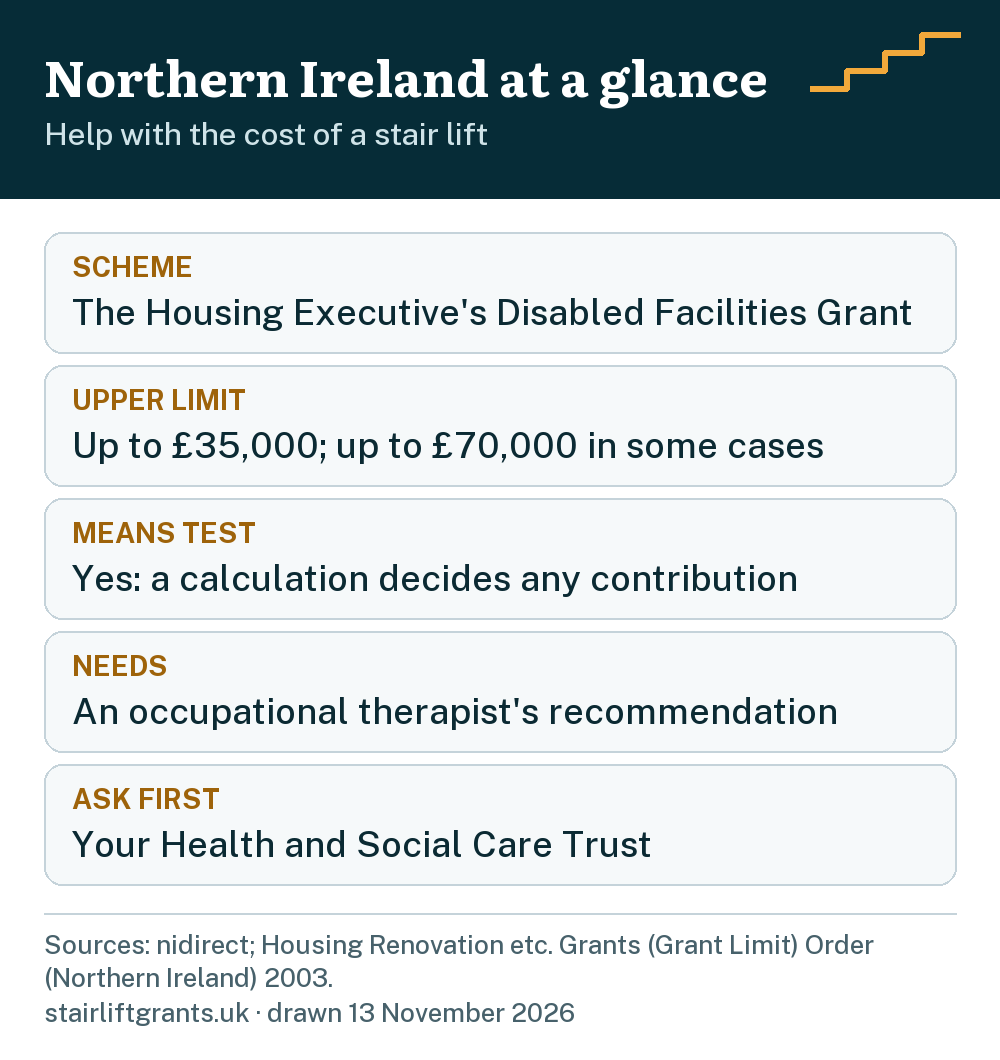
Stair lift help in Northern Ireland at a glance
| Question | Answer | Source, checked 13 Nov 2026 |
|---|---|---|
| Who runs it? | The Northern Ireland Housing Executive | nidirect |
| Are stair lifts covered? | They can be: nidirect lists stair lifts among its "Examples of equipment and adaptations", and says you "may be entitled" to the grant for large equipment classed as an adaptation | nidirect, equipment around the home |
| Upper limit | Up to £35,000; "in some cases" up to £70,000 | the 2003 grant limit order, article 2 |
| Who can get help | Owner occupiers, landlords and private tenants, where a disabled person lives in the house | nidirect |
| How it starts | With your Health and Social Care Trust; your GP or social worker can help | nidirect |
| Means test | Yes: "A calculation will be made to decide if you have to make a contribution." | nidirect |
| Before approval | "Work must not start until you have approval from the Housing Executive." | nidirect |
| Decision | In writing, "not later than 6 months after the date of the application concerned" | the 2003 Order, article 65 |
| After approval | The works must be carried out within 12 months of approval, or "such further period as the Executive may allow" | the 2003 Order, article 68 |
| Social housing tenants | Through the landlord, after an occupational therapist's assessment | nidirect, adapting your home |
The limit: £35,000, or £70,000 in some cases
The limit is set by a Northern Ireland order of 2003. Its revised text says the most the Housing Executive may pay on a Disabled Facilities Grant is £35,000, and that for some kinds of work it may "pay a further amount" as long as the total does not exceed £70,000. nidirect gives the same two figures in plain words: "If you are on a low income you may get grant aid up to a maximum of £35,000. In some cases NIHE may increase the award up to a maximum of £70,000." Sources: Housing Renovation etc. Grants (Grant Limit) Order (Northern Ireland) 2003, article 2 (revised text) (checked 13 Nov 2026); nidirect: Disabled Facilities Grants (checked 13 Nov 2026)
GOV.UK's guide still shows "Up to £25,000" for Northern Ireland. That was the limit before 1 February 2023, when the sums in the order were replaced. Two of the pages that rank for "stairlift grants" repeat the old figure. If you see £25,000 beside Northern Ireland anywhere, it is out of date.
For a stair lift the limit is rarely the issue: it is the most the Housing Executive may pay, not what a stair lift costs. What decides your grant is the occupational therapist's recommendation and the calculation of what you can contribute. Sources: Housing Renovation etc. Grants (Grant Limit) Order (Northern Ireland) 2003, article 2 (revised text) (checked 13 Nov 2026); nidirect: Disabled Facilities Grants (checked 13 Nov 2026); GOV.UK: Disabled Facilities Grants, what you'll get (checked 13 Nov 2026)
How it starts: the health trust, not a form
nidirect's instruction is: "Contact your local Health and Social Services Trust, who will answer your questions, start the process and contact the Housing Executive. You can also speak to your GP or social worker." Its page on adapting your home adds that you "may be able to refer yourself to the Occupational Therapy service", or that your GP or another health professional involved in your care can help you get in touch.
The recommendation is the gate. Three rules follow from it:
- Only recommended work counts. "Only works recommended by your local occupational therapist, unless agreed differently by the local health trust and the Northern Ireland Housing Executive (NIHE), can be considered for grant aid."
- The trust contacts the Housing Executive, not you. In nidirect's "How to apply", the first step is your local Health and Social Services Trust.
- Ask the trust before paying for a private assessment. nidirect's page on adapting your home says: "An occupational therapist must make the recommendation to the Housing Executive."
Can the grant help with a stair lift? nidirect's page on equipment for use around the home lists stair lifts among its "Examples of equipment and adaptations", and adds: "Some large equipment may be classed as adaptations. You may be entitled to a Disabled Facilities Grant to help pay for these." Its grants page's list of typical work does not name stair lifts; it names "improving access to your bathroom, living room or bedroom" instead. So the answer is "may", and whether a stair lift is the right answer for your home is the therapist's call. Sources: nidirect: equipment for use around the home (checked 13 Nov 2026); nidirect: Disabled Facilities Grants (checked 13 Nov 2026); nidirect: adapting your home (checked 13 Nov 2026)
Who can get it, and what you may pay
"Owner occupiers, landlords or private tenants can get help to carry out adaptations if there is a person with a disability living in the house." That covers most private homes. Tenants of the Housing Executive and of housing associations have a different route, set out below.
The grant is means-tested. nidirect says: "The amount of grant paid depends on the approved cost of the work and your financial circumstances", and "A calculation will be made to decide if you have to make a contribution." The rules of that calculation for Northern Ireland have not been checked for this site, so it does not describe them or estimate anyone's share, including where the adaptation is for a child. Ask the Housing Executive's grants office, which nidirect says "will answer your questions at any stage of the process". Source: nidirect: Disabled Facilities Grants (checked 13 Nov 2026)
If you want more done than the therapist recommends, you can: "You can do other work, but the costs for this will have to be paid by you and will not be grant-aided by the Housing Executive." Source: nidirect: Disabled Facilities Grants (checked 13 Nov 2026)
Approval, the two clocks and payment
- Wait for the Housing Executive's written approval. "Work must not start until you have approval from the Housing Executive." That includes ordering or fitting a stair lift. By law it must tell you in writing whether it approves or refuses "as soon as reasonably practicable, and, in any event, not later than 6 months after the date of the application concerned".
- Finish within 12 months of approval. It is a condition of payment that the works are carried out "within 12 months from" the date of approval, or "such further period as the Executive may allow".
- Payment when the work is accepted. nidirect says you are paid "when the work is finished and acceptable to the Occupational Therapist and the Housing Executive" and you have sent it "all accounts, receipts and certificates". Payments during the work are possible "if the grants' manager agrees to this".
If you are older or have particular needs, nidirect says the Housing Executive "has arrangements with independent agencies to help you" with the application. Sources: The Housing (Northern Ireland) Order 2003, article 65: notice of decision (revised text) (checked 13 Nov 2026); The Housing (Northern Ireland) Order 2003, article 68: works to be done within 12 months (revised text) (checked 13 Nov 2026); nidirect: Disabled Facilities Grants (checked 13 Nov 2026)
If you rent from the Housing Executive or a housing association
Social tenants do not use the grant. nidirect explains that "a range of minor adaptation works are available from your social landlord without the need for an occupational therapy assessment", while "major adaptation works will need the assessment of an occupational therapist. After identifying your needs the occupational therapist will send recommendations to your social landlord. They will make the necessary arrangements for the agreed works." nidirect's page for Housing Executive tenants says the Housing Executive "is responsible for doing certain major adaptations to tenants' homes".
A private tenant can apply for the grant like an owner. For how tenure changes the route in each nation, see a stair lift in a council house or rented home. Sources: nidirect: adapting your home (checked 13 Nov 2026); nidirect: adaptations in Housing Executive property (checked 13 Nov 2026); nidirect: Disabled Facilities Grants (checked 13 Nov 2026)
Northern Ireland, not the Republic of Ireland
Searches for a stair lift grant "in Ireland" often bring up pages about grants in the Republic of Ireland. Those are a different state's schemes, with their own rules and their own forms, and none of them applies to a home in Northern Ireland. In Northern Ireland the grant is the Housing Executive's, as described on this page.
VAT relief on a stair lift works the same here as in the rest of the UK and does not depend on the grant: see stairlift VAT relief. To compare Northern Ireland with England, Scotland and Wales, use the rules table or the route checker.