Why a stair lift is a typical grant job
The Disabled Facilities Grant pays for changes to a home so that a disabled person can live there. GOV.UK's list of examples includes "improve access to rooms and facilities, for example with a stairlift, or level access shower". A stair lift is named, not implied. Source: GOV.UK: Disabled Facilities Grants, overview (checked 13 Nov 2026)
The guidance that tells councils in England how to run the grant goes further. It draws a line between small equipment and larger items: equipment that "can be installed and removed easily" is for social services, while "for larger items such as stairlifts and through-floor lifts which may require structural works to the property, help is normally provided through the DFG". It also says "a stairlift could be the relevant works to meet the purpose of accessing a room usable for sleeping", and that where more than one answer would work the council "would usually choose the lower cost option", for example a stair lift or an existing ground-floor room rather than a new bedroom. Source: GOV.UK: Disabled Facilities Grant delivery, guidance for local authorities in England (checked 13 Nov 2026)
So a stair lift is often the answer a council prefers, because it costs less than building. That does not make it automatic. The grant belongs to your council, which runs it under its own policy: council grants for stairlifts sets out what a council must do and what it may add. It is not a national scheme, as government grants for stairlifts explains, and it is not the NHS's, even though the assessment may come through health or social care, which is covered in stairlifts and the NHS.
The two tests the council applies
Before it approves anything, the council "needs to be happy that the work is":
- "necessary and appropriate to meet the disabled person's needs"; and
- "reasonable and can be done, depending on the age and condition of the property".
The first test is about the person, which is why the council "may send an occupational therapist or trained assessor to see you". The second is about the home: whether a stair lift can be fitted safely to these stairs. Those two tests are the reason no website, this one included, can tell you whether you will get the grant. The assessment decides the first, and a look at the staircase decides the second. Sources: GOV.UK: Disabled Facilities Grants, eligibility (checked 13 Nov 2026); GOV.UK: Disabled Facilities Grants, how to apply (checked 13 Nov 2026)
What the grant can include on a stair lift job
| Item | In the grant? | Source, checked 13 Nov 2026 |
|---|---|---|
| The stair lift itself | Yes: a stairlift is one of GOV.UK's named examples | GOV.UK, overview |
| Fitting it | Yes: the installation is part of the work the grant is worked out on | Guidance for councils |
| A warranty or service contract | A council may include it, if it is paid for at the start, when the lift is commissioned | Guidance for councils, paragraph 5.27 |
| VAT | Where VAT is properly charged it is part of the cost; a qualifying lift for a disabled person is usually supplied without it | Guidance for councils; GOV.UK, VAT relief |
| Professional fees | Yes, where the council asks you to use an architect or surveyor | GOV.UK, eligibility |
| Repairs after a breakdown | No: repairs maintain the lift, they do not form part of the grant | Guidance for councils |
Applications "are normally required to include at least 2 estimates from different contractors". And since the guidance calls it good practice to arrange servicing "at the time of installation", ask about it before approval, not after the first fault. Source: GOV.UK: Disabled Facilities Grant delivery, guidance for local authorities in England (checked 13 Nov 2026)
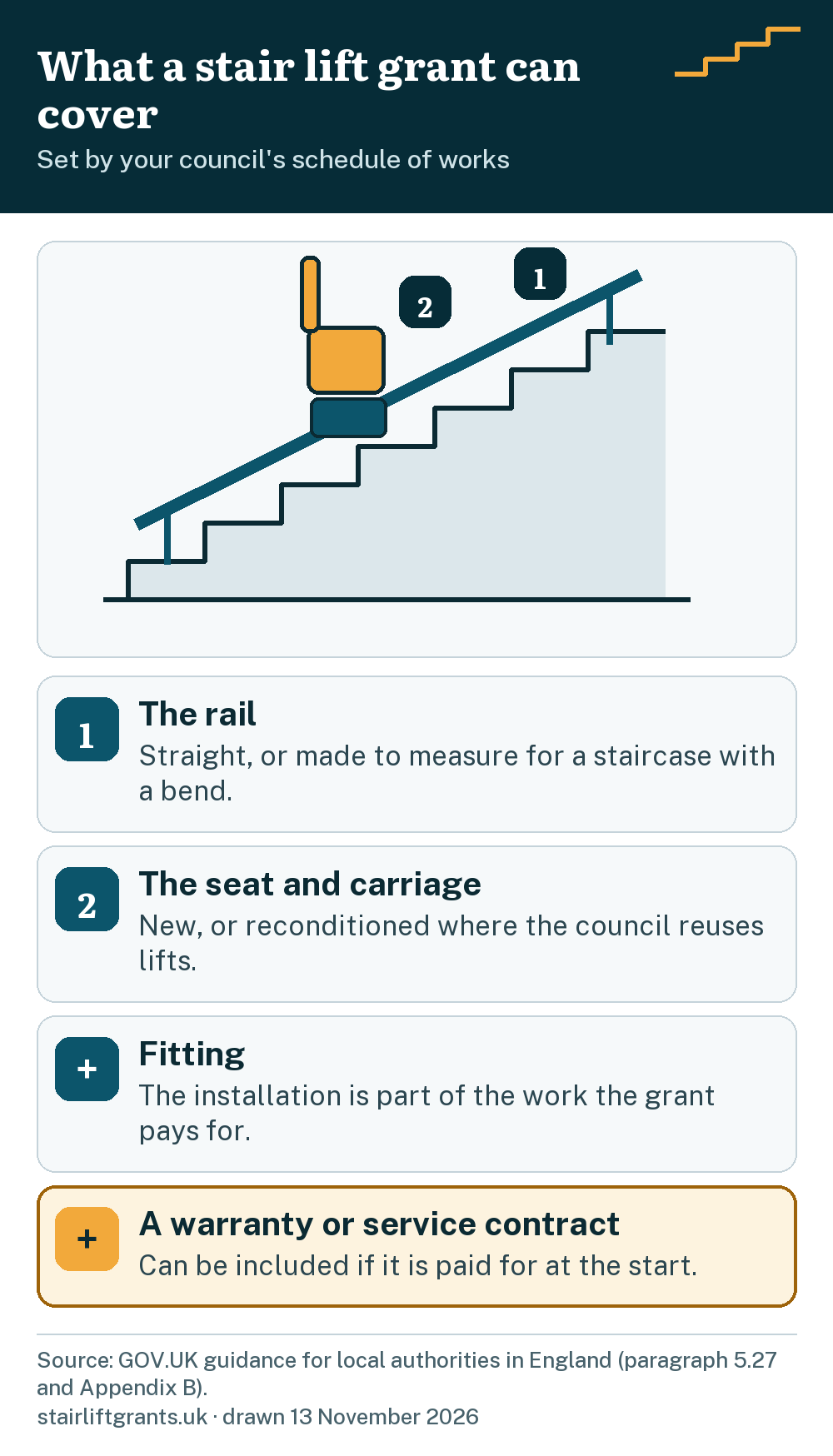
A straight staircase or a curved one
The grant's rules are the same whatever shape your stairs are. There is no separate limit for a curved stair lift and no separate test. The council asks the same two questions: is a stair lift needed, and can one be fitted here?
What changes is the price, because a curved rail is made to fit one staircase. As a guide only, Which? reported in August 2026, from figures manufacturers gave it for 2026, that standard straight stair lifts typically range from £2,000 to £4,000 and custom curved models from £4,500 to £8,000 or more. Those are makers' figures, not prices people paid, and Which? advises checking whether a quote includes VAT. Either way, a stair lift sits far below England's £30,000 limit and Wales's £36,000. Source: Which?: buying and installing a stairlift (24 August 2026) (checked 12 Nov 2026)
So on a stair lift job, straight or curved, the limit rarely decides the grant: the means test does.
After the fitting: who owns it, and who repairs it
Here councils differ, and the time to find out is before approval. Walsall Council's published policy for 2026 to 2030 is a clear example of one approach: "When equipment is installed using a DFG the applicant who was awarded the grant becomes the owner of the equipment and is therefore responsible for its maintenance, repairs and for removing the equipment once it is no longer needed." Walsall adds, as its own discretionary help "whilst resources allow", "a total of a 5-year warranty and service contract" on lifts it arranges, and it "strongly" recommends that people "plan financially" for servicing and repairs after that. Source: Walsall Council: housing renewal assistance policy 2026 to 2030, section 10.5 (maintenance) (checked 13 Nov 2026)
Other councils keep the stair lift as theirs. The guidance for councils in England says authorities "should consider how these items can be reclaimed, refurbished and recycled", and a council may make it a condition of the grant that "specialist equipment, such as a stairlift, may be recovered where it is no longer required". In parts of Scotland owners do not own the stair lift at all: the Scottish Government's guidance describes areas where "owners do not own the stairlifts, and are therefore no longer required to maintain these themselves". Sources: GOV.UK: Disabled Facilities Grant delivery, guidance for local authorities in England (checked 13 Nov 2026); gov.scot: equipment and adaptations, guidance on provision (adaptations and housing solutions) (checked 13 Nov 2026)
Before the grant is approved, ask the council three things:
- Will the grant include a warranty or service contract, and for how long?
- Who will own the stair lift, and who pays for repairs once the cover ends?
- Will the council want it back when it is no longer needed?
Conditions that come with the grant
The grant comes with conditions, and none of them should worry someone who means to stay. The disabled person must intend to live in the home during the grant period, "usually 5 years". The guidance for councils says that where that intention was genuine, no repayment is required if circumstances change and they can no longer live there as planned.
For owners in England, a council may place a local land charge on the home where the grant is more than £5,000: at most £10,000, and only if the home is sold within 10 years of the work being certified. It is a discretion in each council's policy, so ask to see it.
Needs change, and the grant allows for that. GOV.UK says "you can apply for another grant for the same property if you need to", and the guidance says there is no restriction on applying again: if you went ahead with the earlier work, a contribution you paid then is set against a new one for 5 years if you rent and 10 years if you own. A stair lift now and a level access shower later is exactly the case it describes. Sources: GOV.UK: Disabled Facilities Grants, eligibility (checked 13 Nov 2026); GOV.UK: Disabled Facilities Grants, what you'll get (checked 13 Nov 2026); GOV.UK: Disabled Facilities Grant delivery, guidance for local authorities in England (checked 13 Nov 2026)