Who pays · The health side

Can you get a stairlift on the NHS?

The NHS's own advice on home adaptations sends you to your council: "Your local council offers a service that assesses your home and recommends changes to help", and its examples include fitting a stairlift. The money then comes from the council's Disabled Facilities Grant. The health side's part is the referral and the assessment, and in Northern Ireland the health trust starts the grant.

Page last reviewed 13 November 2026. Every figure links to its source and shows the date it was checked. Published by SEO-DONS LTD: not a council, a government body or the NHS.

What the NHS's own page says

The clearest answer to this question is on the NHS website itself, in its social care guide to home adaptations. It says home adaptations "make it safer and easier to move around and do everyday tasks", and that changes "can be small or big and include: fitting a stairlift or a banister on the stairs". Then it says who does it: "Your local council offers a service that assesses your home and recommends changes to help. Having a home assessment is free."

On paying, the same page says that for expensive adaptations "you can try to get a grant from" the Disabled Facilities Grant or Independence at Home, and that a home improvement agency "can help you find schemes to help with the cost of adaptations". In other words, the NHS points you to the council's grant. Source: NHS: home adaptations (checked 13 Nov 2026)

That grant is the subject of the Disabled Facilities Grant for a stairlift, and what your council may add on top of it is on council grants for stairlifts.

Who does what: the health side and the council side

Health and care work closely on adaptations, which is why people expect the NHS to supply the lift. The roles divide like this.

The health side and the council side of a stair lift
StepWho does itSource, checked 13 Nov 2026
Spotting the needAnyone: you, family, your GP, a hospital team. In England you can ask the council yourselfNHS, home adaptations
The home assessmentAn occupational therapist, arranged by the council's social services (England) or the health trust (Northern Ireland)NHS; nidirect
Deciding and payingThe council's grant; in Northern Ireland the Housing Executive'sGOV.UK, how to apply
Small equipmentSocial services, for equipment that "can be installed and removed easily"Guidance for councils

The guidance for councils in England sets the line: small equipment that is easy to fit and remove is the social services authority's, while for "larger items such as stairlifts and through-floor lifts which may require structural works to the property, help is normally provided through the DFG". So the stair lift itself sits with the grant. Source: GOV.UK: Disabled Facilities Grant delivery, guidance for local authorities in England (checked 13 Nov 2026)
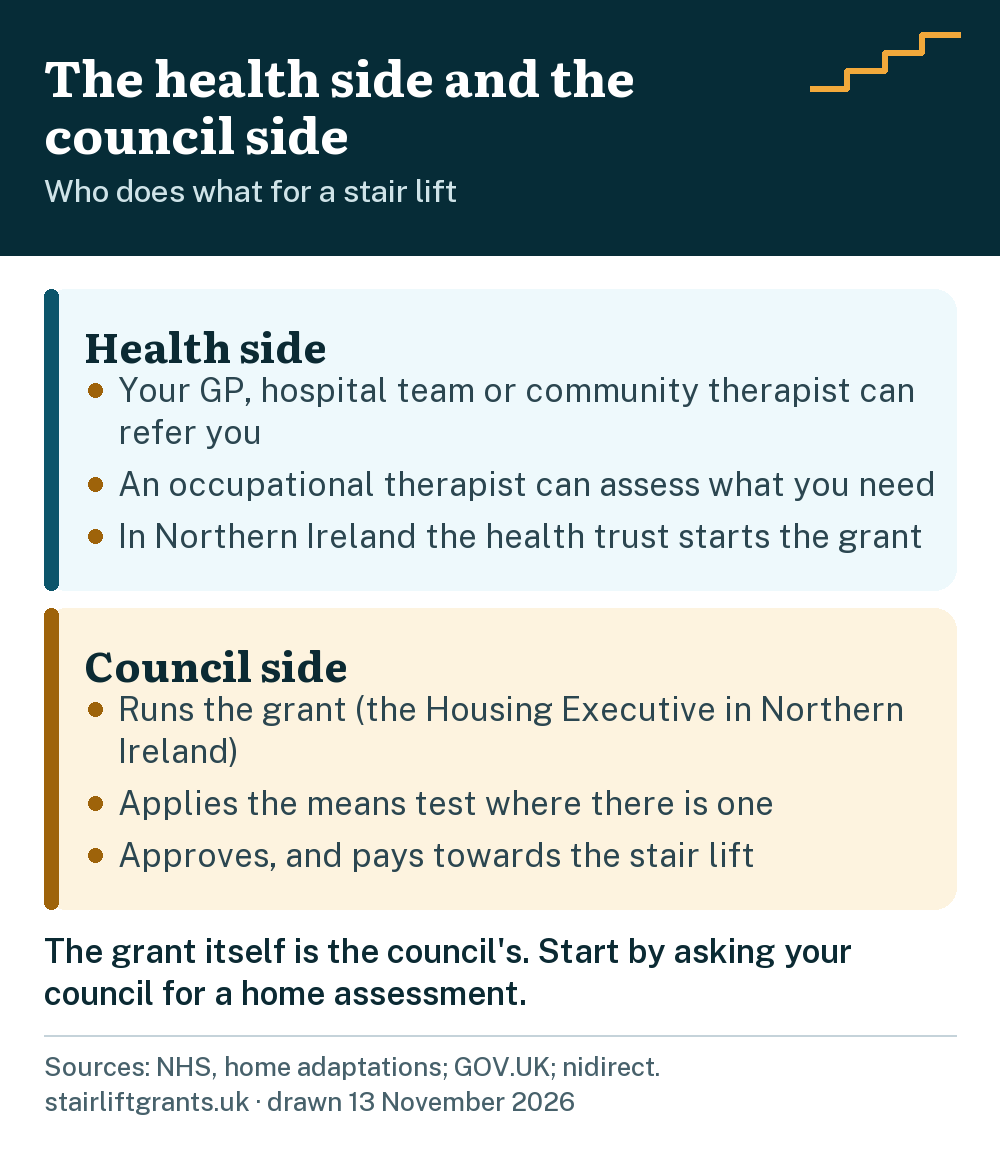
The health side and the council side, for a stair lift. Health side: your GP, hospital team or community therapist can refer you; an occupational therapist can assess what you need; in Northern Ireland the health trust starts the grant. Council side: runs the grant (the Housing Executive in Northern Ireland); applies the means test where there is one; approves, and pays towards the stair lift. Start by asking your council for a home assessment.
Who does what. Sources: NHS, GOV.UK and nidirect, checked 13 Nov 2026.

How it works in each nation

  • England. "If you, or someone you know, needs help to do everyday tasks or you're worried about falling, ask social services for an assessment for equipment or home adaptations. You can call your local council or do it online." The grant that follows is the council's.
  • Scotland. Contact the council's social work team, which arranges a care needs assessment. Some areas provide stair lifts through their community equipment services, lending the lift rather than paying a grant, while others fund them as adaptations.
  • Wales. Home owners contact the local authority, which may send an occupational therapist; tenants contact their landlord.
  • Northern Ireland. Here the health side starts the grant. You contact your Health and Social Care Trust, its occupational therapist recommends the work, and the Housing Executive decides. Your GP or social worker can help you get in touch.

Sources: NHS: home adaptations (checked 13 Nov 2026); mygov.scot: how to apply for care equipment or home adaptations (checked 13 Nov 2026); gov.scot: equipment and adaptations, guidance on provision (recycling) (checked 13 Nov 2026); GOV.WALES: adapt your home, how to apply (checked 13 Nov 2026); nidirect: Disabled Facilities Grants (checked 13 Nov 2026)

If you are coming home from hospital

A hospital stay is often when stairs become the problem, and it is when people most expect the health service to act. Ask the ward team or the discharge team to refer you for a home assessment early, so it is not left until the day you leave.

Some councils have their own help for this moment. The guidance for councils in England lists, as one thing a local policy can offer, a "hospital discharge grant: funding for urgent adaptations, repairs or modifications that will allow someone to be discharged from hospital sooner". In Wales a quick route for small changes, such as rails, works on referral from a health or social care professional, though its list does not include stair lifts. Whatever is arranged, the usual rule holds: a stair lift is ordered after the council approves it, not before. Sources: GOV.UK: Disabled Facilities Grant delivery, guidance for local authorities in England (checked 13 Nov 2026); GOV.WALES: adapt your home when returning from hospital (checked 12 Nov 2026)

What to ask, and who to ask

  1. Ask the council's social services, or your health trust in Northern Ireland, for a home assessment. Say clearly that the stairs are the difficulty.
  2. Tell them everything you find difficult. The NHS's advice is: "Make sure you tell them everything you find difficult, even small things such as opening a cupboard."
  3. Have someone with you if it helps. The NHS suggests a friend or relative, who can also take notes.
  4. Ask about the grant at the same time, and how the council means-tests it.

If you are unhappy with the assessment, the NHS says to complain to the council first, and then to the local government and social care ombudsman. Many people also ask whether there is a national scheme instead of the council's; there is not, which government grants for stairlifts explains. Source: NHS: home adaptations (checked 13 Nov 2026)

Get a stair lift quote and see which grant route fits

Tell us where the stair lift is for and how you expect to pay. Your details go to SEO Dons Ltd, the company that publishes this website, and we reply by email about a quote and the grant route that matches what you have told us. You don't have to buy anything.

What happens next

  1. Your enquiry reaches SEO Dons Ltd. We are a publisher: not a council, not the NHS and not a stair lift company.
  2. We reply by email about your stair lift quote, and name the grant route that fits your nation and your home.
  3. Sending this form is not a grant application. Only your council, or the Housing Executive in Northern Ireland, takes one and decides it.

You don't have to buy anything.

What to expect from a council grant

  1. A means test, in most placesIn England the amount usually depends on income and on savings over £6,000; Northern Ireland works out a contribution too. Most Welsh councils do not test a stair lift grant.
  2. An assessment at homeAn occupational therapist or trained assessor looks at what you need before anything is agreed.
  3. A decision within 6 monthsIn England and Wales the council must say yes or no no later than six months after the date of the application. The wait for an assessment comes before that clock starts.
  4. No work before approvalOrdering, signing or fitting first can cost you the whole grant.

Sources: GOV.UK, what you'll get, GOV.UK, how to apply, the 1996 Act, section 34, nidirect and GOV.WALES, all checked 13 Nov 2026.

Don't order, sign or start before approval GOV.UK says: You might not get any grant if you start work on your property before the council approves your application. That covers ordering and fitting a stair lift. GOV.UK, eligibility (checked 13 Nov 2026)

Add a little more about the home (optional)

Published by SEO Dons Ltd. We are not a council and we don't fit stair lifts. We reply by email. See our privacy notice.

Questions people ask about this

Do I need my GP to refer me for a stair lift?

Not in England. The NHS's advice is to ask social services for an assessment yourself, by calling the council or applying online. In Northern Ireland your GP or social worker can help you reach the health trust's occupational therapy service, and nidirect says you may be able to refer yourself.

Is the home assessment charged for?

The NHS's page on home adaptations says: "Having a home assessment is free." The assessment is how the council works out what you need, whether or not a stair lift turns out to be the answer.

What happens at the assessment?

The NHS says an occupational therapist visits, asks questions and walks round the home with you to see what you struggle with. It usually takes at least an hour. Tell them everything you find difficult, and have a friend or relative with you if that helps.

I am in hospital. Can a stair lift be sorted before I go home?

Ask the ward team or the hospital's discharge team to refer you for a home assessment as early as possible. Some councils have their own hospital discharge help for urgent adaptations, and in Wales there is a quick route for small changes such as rails. A stair lift still needs the council's approval before it is ordered.

Sources for this page

  1. NHS: home adaptations (checked 13 Nov 2026; page last reviewed 12 December 2025)
  2. GOV.UK: Disabled Facilities Grants, overview (checked 13 Nov 2026)
  3. GOV.UK: Disabled Facilities Grants, how to apply (checked 13 Nov 2026)
  4. GOV.UK: Disabled Facilities Grant delivery, guidance for local authorities in England (checked 13 Nov 2026; 28 March 2022)
  5. nidirect: Disabled Facilities Grants (checked 13 Nov 2026; updated 22 September 2026)
  6. nidirect: adapting your home (checked 13 Nov 2026; updated 11 June 2025)
  7. mygov.scot: how to apply for care equipment or home adaptations (checked 13 Nov 2026; updated 23 September 2025)
  8. gov.scot: equipment and adaptations, guidance on provision (recycling) (checked 13 Nov 2026; 17 January 2023)
  9. GOV.WALES: adapt your home when returning from hospital (checked 12 Nov 2026)
  10. GOV.WALES: adapt your home, how to apply (checked 13 Nov 2026)

Rules change, and councils differ. If an official page says something different from this one, the official page is right: tell us through the contact page and we will correct it. How we check facts is on sources and checks.

Get a stair lift quote