VAT relief is the one help with the cost of a stair lift that works the same in all four nations. It is set in tax law, not by a council, it is not means-tested and it does not depend on getting a grant. It comes in two forms, and the difference between them is the most common mistake people make about stair lifts and VAT. Sources: Value Added Tax Act 1994, Schedule 8, Group 12 (checked 12 Nov 2026); Value Added Tax Act 1994, Schedule 7A, Group 10 (checked 12 Nov 2026)
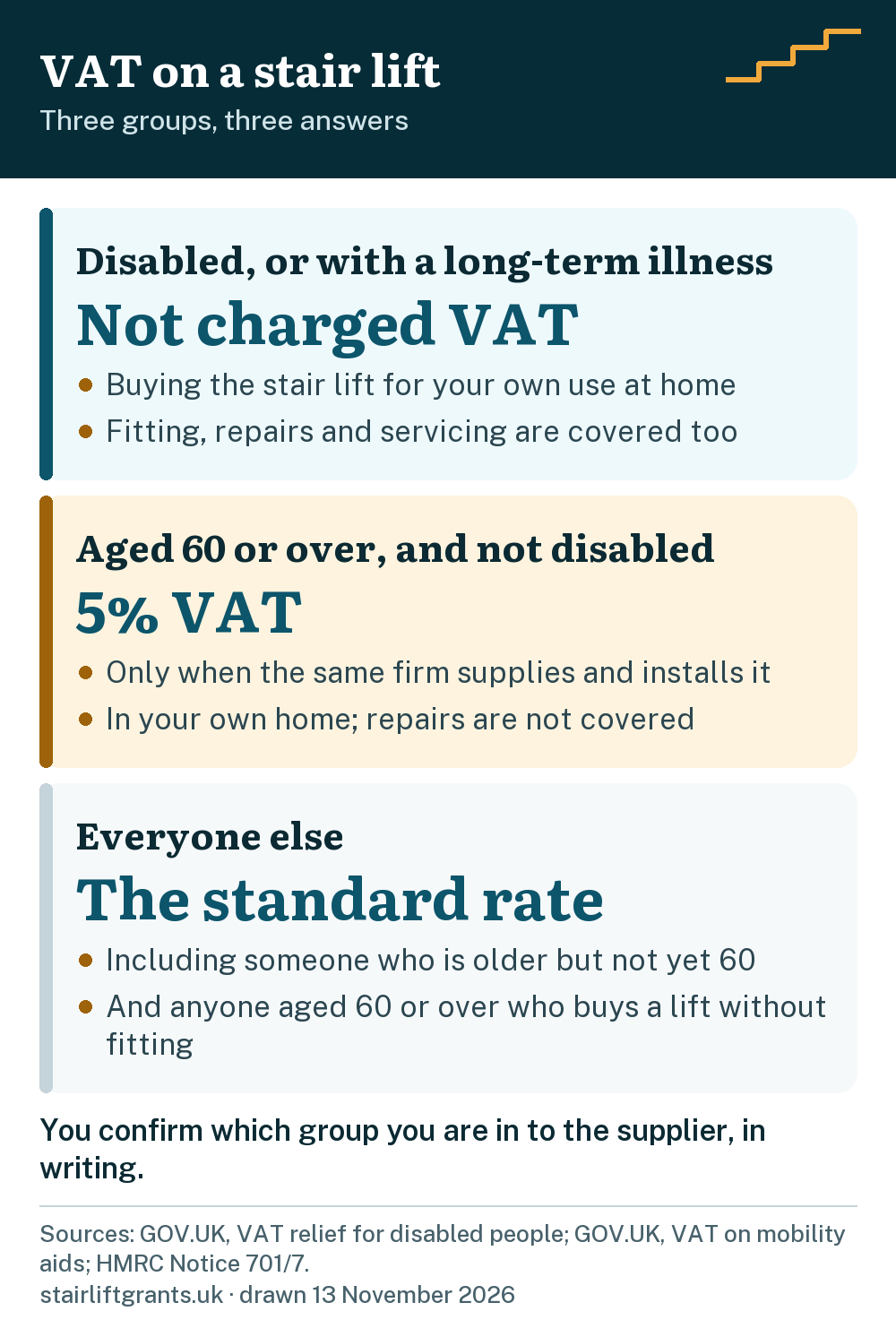
Who is not charged VAT on a stair lift
GOV.UK puts the main rule simply: "If you're disabled or have a long-term illness, you will not be charged VAT on products designed or adapted for your own personal or domestic use." It adds that you will not be charged VAT on "the installation and any extra work needed as part of this", on "repairs or maintenance", or on "spare parts or accessories".
For VAT, you count as disabled or as having a long-term illness if:
- "you have a physical or mental impairment that affects your ability to carry out everyday activities";
- "you have a condition that's treated as chronic sickness, like diabetes"; or
- "you're terminally ill".
Two groups are left out, in GOV.UK's words: "You do not qualify if you're elderly but not disabled, or if you're temporarily disabled." HMRC's notice gives "a broken limb" as an example of being only temporarily disabled. HMRC also says it "cannot offer any specific advice about whether or not any particular individual customer is chronically sick or disabled": the declaration you sign is what the supplier relies on. Sources: GOV.UK: VAT relief for disabled people (checked 13 Nov 2026); GOV.UK: HMRC VAT Notice 701/7, reliefs from VAT for disabled and older people (checked 13 Nov 2026)
Which stair lifts qualify
The person has to qualify, and so does the product. GOV.UK says "your supplier can tell you, but usually products designed or adapted for a disability qualify", and lists stair lifts among its examples. HMRC's notice, which suppliers follow, words the stair lift item more narrowly: a supplier can zero-rate "a stair lift or a chair lift designed for use in connection with a wheelchair (it is not necessary for the lift to carry the person whilst seated in the wheelchair)".
So do not assume every stair lift is covered. Ask the supplier, before you order, whether the lift qualifies and under which part of the rules, and get the answer on the quote. The relief also covers repairing and maintaining a qualifying lift, and supplying it on hire to someone who qualifies. Sources: GOV.UK: VAT relief for disabled people (checked 13 Nov 2026); GOV.UK: HMRC VAT Notice 701/7, reliefs from VAT for disabled and older people (checked 13 Nov 2026)
Who can pay, and who cannot
"As a general rule, anyone can pay for the eligible goods and services", so a son or daughter can pay for a qualifying parent's stair lift and the relief still applies. It is for one person's own use: HMRC's notice gives a stair lift in a charity building, "made available for the general use" of everyone who might need it, as an example that does not qualify.
Source: GOV.UK: HMRC VAT Notice 701/7, reliefs from VAT for disabled and older people (checked 13 Nov 2026)
The 5% rate if you are aged 60 or over
If you are not disabled but are aged 60 or over, there is a smaller relief. GOV.UK: "you pay a reduced rate of VAT (5%) on certain mobility aids when you pay for them to be supplied and installed in your home." Stair lifts are on its list, with grab rails, ramps, bath lifts, built-in shower seats and walk-in baths with sealable doors. You qualify if:
- you are 60 or over when the product is supplied or installed;
- the product is installed: "you do not get the reduced rate if you just buy it";
- it is for a private home, "for example your own home or one shared with friends or relatives (a residential care home does not qualify)".
It does not cover later work: "You do not get the reduced rate if you repair or replace the goods after they've been installed." And you do not have to pay yourself: "a friend, local council, charity or housing association can do it for you". GOV.UK's guide says "over 60", and the law and HMRC's notice say "aged 60 or over", which is the wording to rely on. Sources: GOV.UK: VAT on mobility aids (checked 13 Nov 2026); Value Added Tax Act 1994, Schedule 7A, Group 10 (checked 12 Nov 2026); GOV.UK: HMRC VAT Notice 701/7, reliefs from VAT for disabled and older people (checked 13 Nov 2026)
If you are both disabled and aged 60 or over, the first relief is the one that applies, because it removes VAT altogether. Age only matters for people who are not disabled, which is the subject of grants for stairlifts for older people.
Who signs, and what HMRC does not do
Both reliefs work the same way: you confirm in writing to the supplier that you qualify, and the supplier does not charge the VAT, or charges 5%. A few points from HMRC's notice and GOV.UK:
- No certificate. HMRC "does not supply an 'exemption certificate'". The supplier holds your written declaration instead.
- A separate statement. The declaration "should be separate, or clearly distinguishable from, any order form or invoice", so signing an order is not the same as declaring.
- Someone else can sign. If you cannot, a supplier "can accept the signature of a parent, guardian, doctor or another responsible person".
- The supplier may give you a form. For the 5% rate GOV.UK also gives a standard wording you can sign yourself.
Sources: GOV.UK: HMRC VAT Notice 701/7, reliefs from VAT for disabled and older people (checked 13 Nov 2026); GOV.UK: VAT relief for disabled people (checked 13 Nov 2026); GOV.UK: VAT on mobility aids (checked 13 Nov 2026)
VAT and a council grant
VAT relief and a grant are separate, and you can have both. If the stair lift qualifies for relief, there is simply no VAT in the price the grant is worked out on. Where VAT is properly charged, the guidance for councils in England says it is included in the estimated cost the grant is based on, like any other part of the cost. Source: GOV.UK: Disabled Facilities Grant delivery, guidance for local authorities in England (checked 13 Nov 2026)
What the grant itself covers on a stair lift job is on the Disabled Facilities Grant for a stairlift. If you are checking every way to lower the cost, VAT is the place to start, because it does not depend on a means test, a waiting list or a decision: only on who the stair lift is for.