England has one scheme for this, and it belongs to your council. The Disabled Facilities Grant is a legal duty of every local housing authority, and GOV.UK's own list of what it can pay for includes improving "access to rooms and facilities, for example with a stairlift". There is no separate stair lift grant and no national office to write to. Source: GOV.UK: Disabled Facilities Grants, overview (checked 13 Nov 2026)
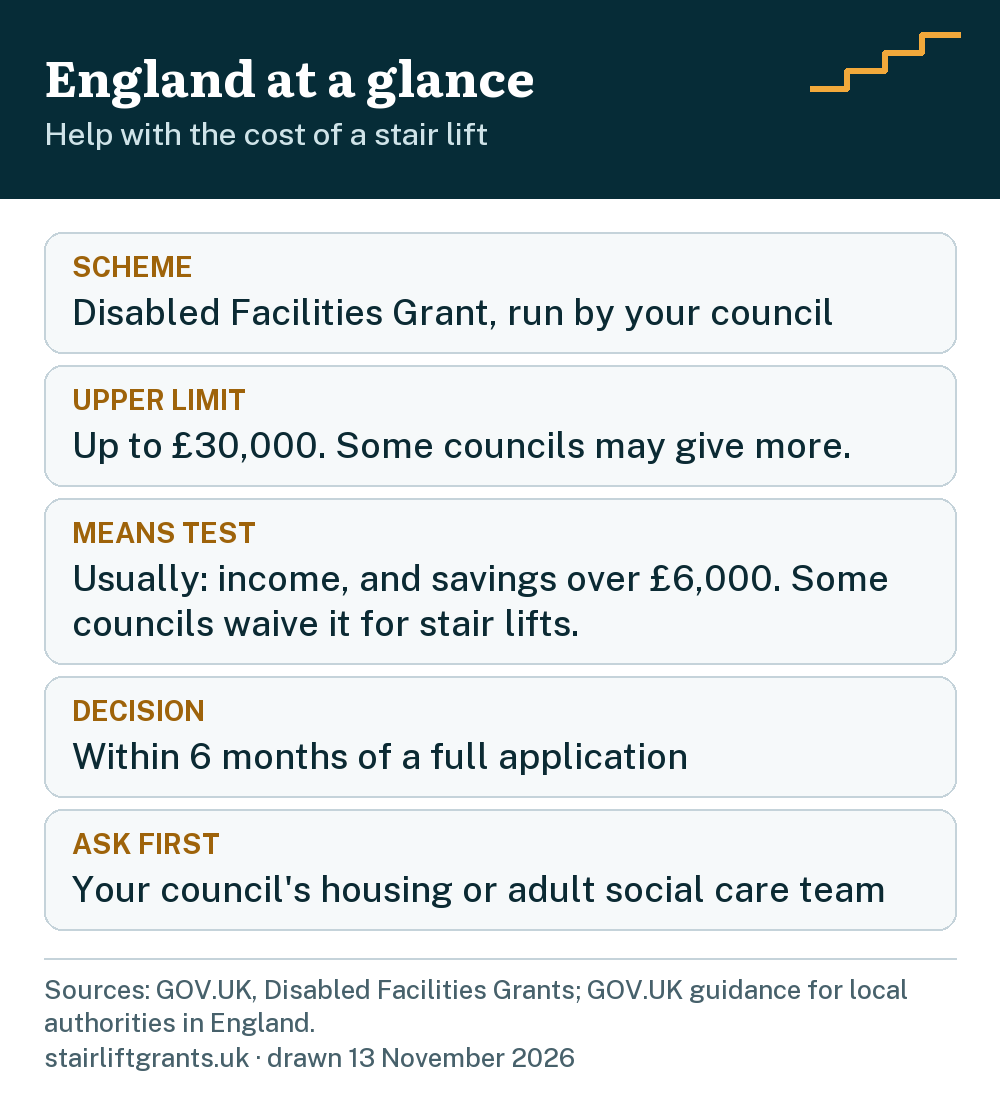
Stair lift help in England at a glance
| Question | Answer | Source, checked 13 Nov 2026 |
|---|---|---|
| Who runs it? | Your local council, as the housing authority | GOV.UK, how to apply |
| Upper limit | Up to £30,000. "Some councils may give more." | GOV.UK, what you'll get |
| Means test | Usually: household income, and household savings over £6,000 | GOV.UK, what you'll get |
| Not means-tested | A disabled child under 18; a landlord's application | GOV.UK, what you'll get |
| Assessment | The council "may send an occupational therapist or trained assessor" | GOV.UK, how to apply |
| Decision | Within 6 months: no later than six months after the date of the application | 1996 Act, section 34 |
| The work | Should be completed within 12 months of approval | GOV.UK, eligibility |
| Before approval | Start work and "you might not get any grant" | GOV.UK, eligibility |
Who can get a stair lift grant in England
GOV.UK sets two conditions on the person and two on the work. You, or someone living in the home, must:
- be disabled. GOV.UK's examples include physical disability, a learning disability, dementia, a progressive condition and "age-related needs";
- intend to live in the property during the grant period, which is usually 5 years and can be shorter, for example for someone who is terminally ill.
The council then has to be satisfied that the work is:
- "necessary and appropriate" to meet the disabled person's needs;
- "reasonable and can be done", given the age and condition of the property.
The application can come from the owner, a tenant or a landlord. If you rent, the route changes a little: a stair lift in a council house or rented home sets out who to ask. Age on its own is not a condition either way, which is covered in grants for stairlifts for older people. Sources: GOV.UK: Disabled Facilities Grants, overview (checked 13 Nov 2026); GOV.UK: Disabled Facilities Grants, eligibility (checked 13 Nov 2026)
Are stairlift grants means tested in England?
Usually, yes. GOV.UK says how much you get "usually depends on" your household income and household savings over £6,000, and warns that "depending on your income, you may need to pay towards the cost of the work". Many applicants are asked to pay something. This site never works out what that would be: the test is the council's to run.
There are four ways the test can fall away:
- The stair lift is for a child. "Disabled children under 18 can get a grant without their parents' income being taken into account."
- A landlord applies. Landlords can get a grant "without their income and savings being taken into account".
- The applicant is already on a means-tested benefit. The guidance for councils treats someone who gets certain benefits, Universal Credit among them, as having no contribution to pay.
- The council has dropped the test for stair lifts. The same guidance gives "not requiring means testing for stairlifts to prevent falls" as an example of what a council's own policy can do.
That last one is real, not theoretical. Chesterfield Borough Council's page says: "We don't currently means test for stairlifts." Waverley Borough Council's says "there is no means test for the installation of rails, ramps, shallow steps or stairlifts". Those are two councils out of nearly 300 in England, so ask your own what its policy says. More on this is in council grants for stairlifts. Sources: GOV.UK: Disabled Facilities Grants, what you'll get (checked 13 Nov 2026); GOV.UK: Disabled Facilities Grant delivery, guidance for local authorities in England (checked 13 Nov 2026); Chesterfield Borough Council: questions about disabled facilities grants (checked 13 Nov 2026); Waverley Borough Council: Disabled Facilities Grant (checked 13 Nov 2026)
How long a stair lift grant takes in England
Two clocks are set in law. The council must tell you whether the application is approved or refused "as soon as reasonably practicable" and no later than six months after the date of the application. Once it is approved, the work should be completed within 12 months, and the council can allow more time.
Those are the outer limits. No official figure for the typical wait was found, so none is quoted here. What is certain is the order: the assessment comes before the application, and the approval comes before the order. A stair lift bought in the gap can cost you the whole grant. Sources: Housing Grants, Construction and Regeneration Act 1996, section 34 (checked 13 Nov 2026); Housing Grants, Construction and Regeneration Act 1996, section 37 (checked 13 Nov 2026); GOV.UK: Disabled Facilities Grants, eligibility (checked 13 Nov 2026)
The money behind it: England's budget for 2026-27
The government confirmed £723 million for the Disabled Facilities Grant in England in 2026-27, after £761 million in 2025-26. It reaches councils through the Better Care Fund and, from 2026-27, is shared out by a new formula based on need, with protection so that no council gets less than it received in June 2025.
For a reader this is context, not a deadline: no scheme is closing. The guidance for councils says authorities "still have a statutory duty to approve" applications that meet the legal requirements, and that a published local policy lets them use the funding "more flexibly", which is where any extra local help comes from. Sources: GOV.UK: government response on how Disabled Facilities Grant funding is shared between councils (checked 12 Nov 2026); GOV.UK: Disabled Facilities Grant delivery, guidance for local authorities in England (checked 13 Nov 2026)
What to do first
- Ask the council for a home assessment. The NHS's advice is to "ask social services for an assessment for equipment or home adaptations", by phone or online. The assessment is not charged for.
- Ask whether the council means-tests stair lifts, and ask for its housing assistance policy.
- Hold off ordering. Get quotes if you want to know the cost, but sign nothing until the approval arrives.
- Check VAT separately. It is not means-tested and it applies whoever pays: see stairlift VAT relief.
Small jobs do not need a grant at all. In England a council must not charge for a minor adaptation costing £1,000 or less that it provides to meet an assessed care need, which covers things like grab rails. Neither source mentions stair lifts, and a stair lift costs more than that, so do not expect one by this route. Sources: NHS: home adaptations (checked 13 Nov 2026); Care and Support (Charging and Assessment of Resources) Regulations 2014, regulation 3 (checked 12 Nov 2026)
If the council refuses and you think it is wrong, GOV.UK says you can appeal to the council and then complain to the Local Government Ombudsman (the NHS's page uses its fuller name, the local government and social care ombudsman). For the other nations, see Scotland, Wales and Northern Ireland, or run the route checker. Source: GOV.UK: Disabled Facilities Grants, how to apply (checked 13 Nov 2026)