Wales shares the Disabled Facilities Grant with England, under the same Act, but two things are different and both help the reader. The limit is higher, and the means test has largely gone for jobs the size of a stair lift. The Welsh Government's guide names the job directly: the changes you can get help with include improving "access to rooms and facilities, for example stair lifts or a downstairs bathroom". Source: GOV.WALES: adapt your home if you are disabled or an older person (checked 13 Nov 2026)
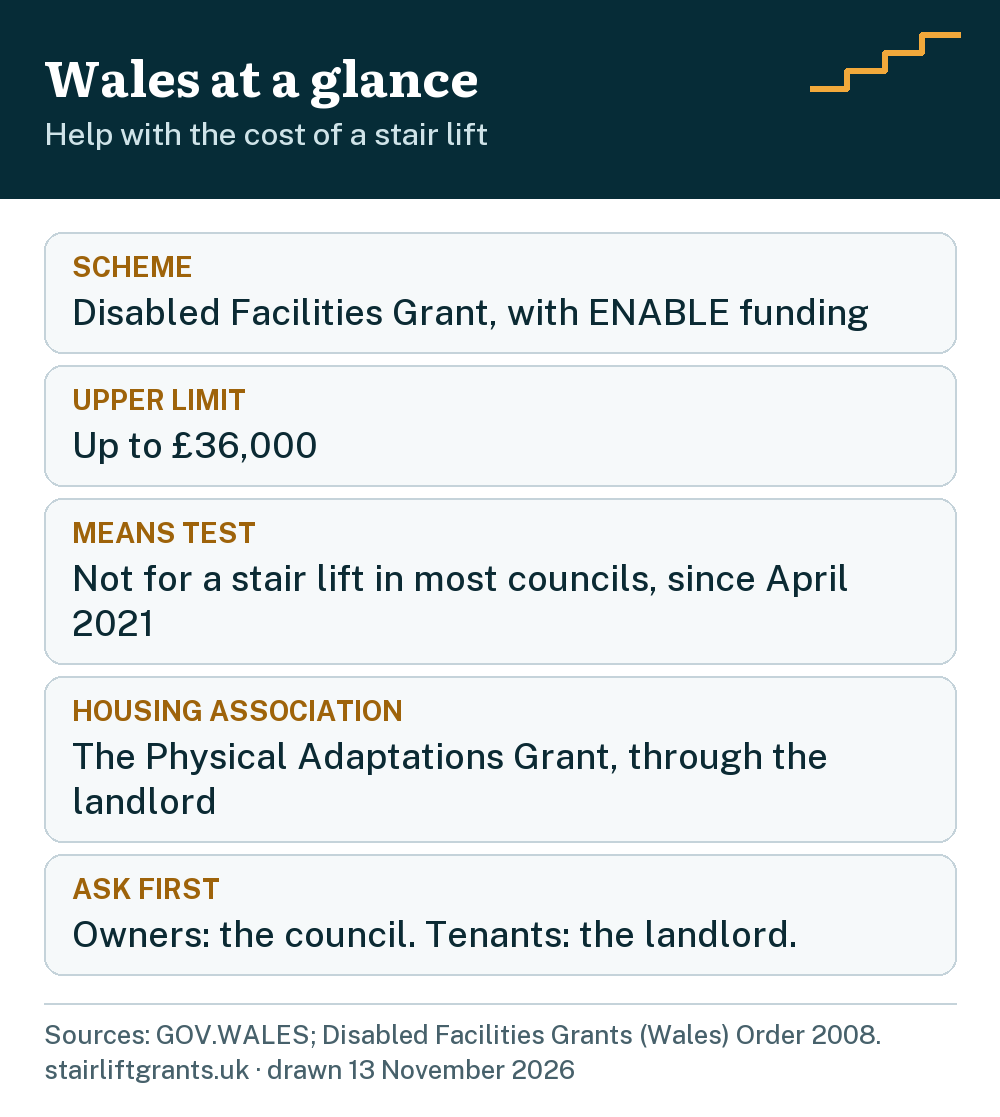
Stair lift help in Wales at a glance
| Question | Answer | Source, checked 13 Nov 2026 |
|---|---|---|
| Which scheme? | The Disabled Facilities Grant and ENABLE: you "can apply for support from 1 or more" | GOV.WALES, adapt your home |
| Upper limit | Up to £36,000 | 2008 Wales order (checked 12 Nov 2026); GOV.UK |
| Means test for a stair lift | Not in most councils, since April 2021 | GOV.WALES written statement |
| Where a stair lift sits | A "medium" adaptation, with walk in showers and large ramps | GOV.WALES, ENABLE |
| Assessment | The local authority "may send an occupational therapist to see you" | GOV.WALES, how to apply |
| Who to ask first | Owners: the local authority. Tenants: the landlord | GOV.WALES, how to apply |
| Housing association tenants | The Physical Adaptations Grant, through the association | GOV.WALES, social housing |
| Decision | No later than six months after the date of the application | 1996 Act, section 34 |
Why most Welsh councils do not means-test a stair lift
On 10 March 2021 the Welsh housing minister announced that "from April 2021 it will be simpler for disabled people to get help with small and medium sized adaptations to their homes as we take measures to remove the means test from small and medium Disabled Facilities Grants". The statement called these grants "the main way" owner occupiers and private tenants get help with "the most common types of adaptations, such as stair lifts, ramps and downstairs toilet and washing facilities".
The way it was done matters, because it explains the word "most". The law was not changed. Instead: "It will be a condition of the Enable grant that local authorities do not means test small and medium DFGs." Councils keep their legal duty to give the grant and use their wider powers to give it without a means test.
A Welsh Government response to an information request in February 2026 shows the condition has not been applied everywhere. In 2023/24 and 2024/25 Caerphilly and Newport still means-tested medium adaptations, while Blaenau Gwent and Cardiff had dropped the test for all grants, large ones included. So the honest wording is "most Welsh councils", and the first question to ask yours is whether it means-tests a stair lift. Sources: GOV.WALES: written statement on removing the means test for small and medium grants (checked 13 Nov 2026); Welsh Government: information request response ATISN 26584 (checked 12 Nov 2026)
What this means against England
Across the border the amount "usually depends on" income and on savings over £6,000, unless the council has chosen to drop the test. In Wales the starting point is the other way round. See stairlift grants in England for the comparison.
ENABLE and the three sizes of adaptation
ENABLE is the Welsh Government's "support for living independently" scheme. Its guide sorts adaptations into three sizes, and the size decides how simple the route is.
- Small: grab rails and stair rails, small ramps, accessible taps, key safes.
- Medium: a walk in shower, chair lifts, large ramps.
- Large: building an extension, a through floor lift, moving a bathroom or kitchen.
A stair lift is a medium adaptation, which is why the means-test change reaches it. The guide lists who can be helped as disabled adults, disabled children and older people.
There is also a quick route for very small jobs when someone is coming home from hospital: the Rapid Response Adaptations Programme, run by Care and Repair agencies on referral from a health or social care professional. Its list covers things like rails and does not include stair lifts, so it will not pay for one, but it can make the stairs safer while a grant is decided. Sources: GOV.WALES: ENABLE, support for living independently (checked 13 Nov 2026); GOV.WALES: adapt your home when returning from hospital (checked 12 Nov 2026)
Who to ask first in Wales
The Welsh Government's guide splits it by who owns the home.
- You own your home: "you should contact your local authority. The local authority may send an occupational therapist to see you. They will check your circumstances and see what changes you need."
- You rent, whether privately, from the council or from a housing association: "you should contact your landlord."
That second line is a real difference from England, where a private tenant usually goes to the council. It is set out for all four nations on a stair lift in a council house or rented home. Source: GOV.WALES: adapt your home, how to apply (checked 13 Nov 2026)
Housing association tenants: the Physical Adaptations Grant
If your landlord is a housing association, there is a separate Welsh Government grant, and its list of work is explicit: "lifts: includes providing stair lifts or through floor lifts". You do not apply for it yourself. The published steps are:
- You contact your housing association and ask for a change to your home.
- "An occupational therapist and a housing association officer will visit you."
- The association agrees the best solution for you and your home.
- "If appropriate your housing association will apply to us for funding for the work."
- The work is done, and the association claims the grant afterwards.
The grant is open to tenants who are disabled or older. It excludes stock transfer housing associations, the landlords that took over former council homes, so their tenants should ask what the landlord offers instead. Source: GOV.WALES: adapt your home if you live in social housing (checked 13 Nov 2026)
How long, and the rule about starting early
The Disabled Facilities Grant in Wales sits under the same 1996 Act as England's, and the section that sets the decision clock extends to England and Wales: the council must say yes or no "not later than six months after the date of the application concerned". GOV.UK's guide, whose table covers Wales, gives the matching warning: "You might not get any grant if you start work on your property before the council approves your application." Order nothing until the approval is in writing. Sources: Housing Grants, Construction and Regeneration Act 1996, section 34 (checked 13 Nov 2026); GOV.UK: Disabled Facilities Grants, eligibility (checked 13 Nov 2026)
If the answer is no, appeal to the local authority first and then to the Public Services Ombudsman for Wales. VAT is a separate matter and works the same across the UK: see stairlift VAT relief. To set Wales beside Scotland and Northern Ireland, use the rules table or the route checker. Source: GOV.WALES: adapt your home, appeals (checked 13 Nov 2026)