The four schemes in one table
Each nation's name links to its own page with the detail. Scroll the table sideways on a phone.
| Nation | Scheme and who runs it | Upper limit | Means test | Assessment | Decision time | Who to ask first | Sources (all checked 13 Nov 2026 unless a date is shown) |
|---|---|---|---|---|---|---|---|
| England | Disabled Facilities Grant Your local council (the housing authority) | Up to £30,000. "Some councils may give more." | Usually yes: the amount "usually depends on" income and savings over £6,000. Not for a disabled child under 18, not for a landlord's application, and some councils waive it for stair lifts. | The council "may send an occupational therapist or trained assessor to see you". | "Your council must give you a decision within 6 months." The work "should be completed within 12 months" of approval. | Your council's housing or adult social care team. | GOV.UK: Disabled Facilities Grants, what you'll get Disabled Facilities Grants (Maximum Amounts and Additional Purposes) (England) Order 2008 (checked 12 Nov 2026) GOV.UK: Disabled Facilities Grant delivery, guidance for local authorities in England GOV.UK: Disabled Facilities Grants, how to apply GOV.UK: Disabled Facilities Grants, eligibility Housing Grants, Construction and Regeneration Act 1996, section 34 NHS: home adaptations |
| Scotland | Scheme of Assistance (mandatory grant) Your local council, starting with its social work team | No upper limit on the cost of the work. The council checks that the cost is reasonable. | No test for the 80% grant: it "does not depend on your income". 100% on five listed benefits. A council's top-up above 80% is usually means-tested. | Required: "You must have an assessment if you want to apply for financial help", usually by an occupational therapist. | No national clock was found in the sources read. Low-priority cases "may have to wait some time", and "limited budgets may also delay" a grant. | Your council's social work team, which arranges a care needs assessment. | gov.scot: funding adaptations to the home, a guide for homeowners Housing (Scotland) Act 2006 (Scheme of Assistance) Regulations 2008 (checked 12 Nov 2026) Scottish regulations of 2013 adding Universal Credit to the list (checked 12 Nov 2026) mygov.scot: how to apply for care equipment or home adaptations |
| Wales | Disabled Facilities Grant, with ENABLE funding Your local council; your landlord first if you rent | Up to £36,000, set by a 2008 order. | Mostly no for a stair lift: since April 2021 it has been a condition of Welsh Government funding that councils do not means-test small and medium grants. Two councils still tested medium adaptations in 2023/24 and 2024/25. | The local authority "may send an occupational therapist to see you". | The same Act as England: a decision no later than six months after the date of the application. | Home owners: the local authority. Private, council and housing association tenants: the landlord. | Disabled Facilities Grants (Maximum Amounts and Additional Purposes) (Wales) Order 2008 (checked 12 Nov 2026) GOV.UK: Disabled Facilities Grants, what you'll get GOV.WALES: written statement on removing the means test for small and medium grants Welsh Government: information request response ATISN 26584 (checked 12 Nov 2026) GOV.WALES: adapt your home, how to apply Housing Grants, Construction and Regeneration Act 1996, section 34 GOV.UK: Disabled Facilities Grants, how to apply |
| Northern Ireland | Disabled Facilities Grant The Northern Ireland Housing Executive, on an occupational therapist's recommendation | Up to £35,000; "in some cases" up to a maximum of £70,000. GOV.UK's table still shows £25,000. | Yes: "A calculation will be made to decide if you have to make a contribution." | Required: "Only works recommended by your local occupational therapist, unless agreed differently by the local health trust and the Northern Ireland Housing Executive (NIHE), can be considered for grant aid." | By law the Housing Executive must say in writing whether it approves or refuses "not later than 6 months after the date of the application concerned". No work may start before approval; then the works must be carried out "within 12 months from" approval, or "such further period as the Executive may allow". | Your local Health and Social Care Trust; your GP or social worker can also start it. | nidirect: Disabled Facilities Grants Housing Renovation etc. Grants (Grant Limit) Order (Northern Ireland) 2003, article 2 (revised text) The Housing (Northern Ireland) Order 2003, article 65: notice of decision (revised text) The Housing (Northern Ireland) Order 2003, article 68: works to be done within 12 months (revised text) nidirect: adapting your home |
Every row was checked on 13 November 2026 against the pages in the right-hand column, apart from the rows marked with an earlier date. The next full check is due by 12 February 2027.
How to read each column
Scheme and who runs it
Three nations use a grant called the Disabled Facilities Grant, but it is run by three different bodies under three sets of law. In England and Wales it is your local council, as the housing authority. In Northern Ireland it is the Housing Executive. Scotland has no grant of that name: its councils help under the Housing (Scotland) Act 2006, through what each publishes as its Scheme of Assistance. Nowhere is there a national stair lift grant run by a government department, which is explained on government grants for stairlifts.
Upper limit
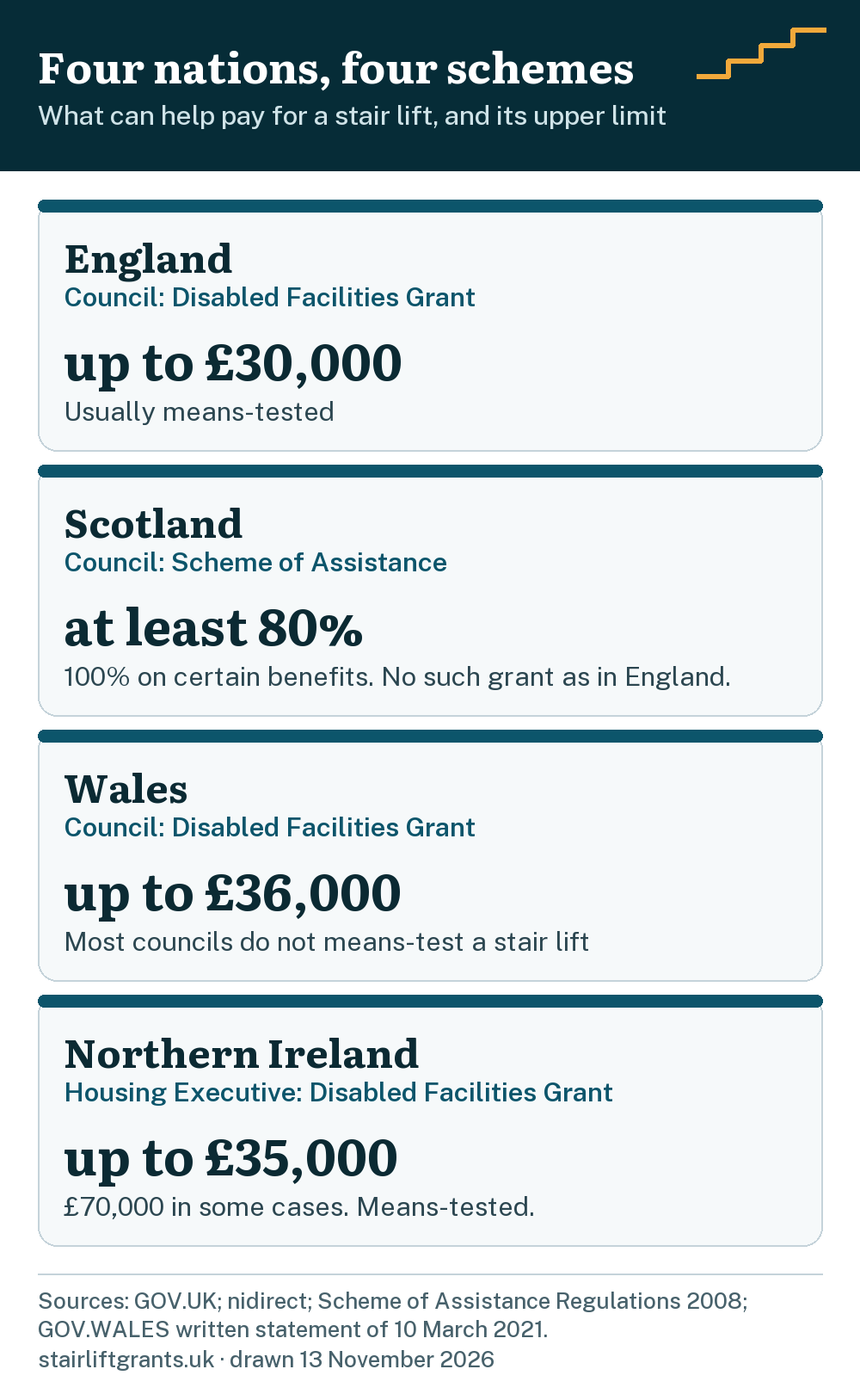
A limit is a ceiling on what the scheme has to pay, never an amount anyone is offered. England's is £30,000, Wales's is £36,000 and Northern Ireland's is £35,000, rising to £70,000 in some cases. Scotland's grant has no cash limit: it is a share of the approved cost. A stair lift costs far less than any of these limits, so on a stair lift job the limit almost never decides the amount. The means test and the council's view of what is needed do. Sources: GOV.UK: Disabled Facilities Grants, what you'll get (checked 13 Nov 2026); Disabled Facilities Grants (Maximum Amounts and Additional Purposes) (Wales) Order 2008 (checked 12 Nov 2026); Housing Renovation etc. Grants (Grant Limit) Order (Northern Ireland) 2003, article 2 (revised text) (checked 13 Nov 2026); gov.scot: funding adaptations to the home, a guide for homeowners (checked 13 Nov 2026)
Means test
This is the column where the nations differ most.
- England: the amount "usually depends on" household income and savings over £6,000. Some councils have dropped the test for stair lifts under their own policy.
- Wales: most councils have not means-tested small and medium grants, stair lifts included, since April 2021. Two councils still tested medium adaptations in 2023/24 and 2024/25.
- Scotland: the basic 80% grant "does not depend on your income"; 100% applies on five listed benefits; a council's top-up is usually means-tested.
- Northern Ireland: "A calculation will be made to decide if you have to make a contribution."
No page on this site works out what a reader would pay: that is for the council or the Housing Executive. Sources: GOV.UK: Disabled Facilities Grants, what you'll get (checked 13 Nov 2026); GOV.WALES: written statement on removing the means test for small and medium grants (checked 13 Nov 2026); Welsh Government: information request response ATISN 26584 (checked 12 Nov 2026); gov.scot: funding adaptations to the home, a guide for homeowners (checked 13 Nov 2026); nidirect: Disabled Facilities Grants (checked 13 Nov 2026)
Assessment
Every nation puts an assessment before the money. In England the council "may send an occupational therapist or trained assessor". In Scotland "you must have an assessment if you want to apply for financial help". In Wales the local authority "may send an occupational therapist". In Northern Ireland nothing happens without the health trust's occupational therapist's recommendation. The assessment is where a stair lift is weighed against other answers, such as moving a bedroom downstairs. Sources: GOV.UK: Disabled Facilities Grants, how to apply (checked 13 Nov 2026); gov.scot: funding adaptations to the home, a guide for homeowners (checked 13 Nov 2026); GOV.WALES: adapt your home, how to apply (checked 13 Nov 2026); nidirect: Disabled Facilities Grants (checked 13 Nov 2026)
Decision time
England and Wales share a clock set by the 1996 Act: the council must decide "not later than six months after the date of the application". The clock starts with the application, so the wait for an assessment comes first. Northern Ireland's 2003 Order sets a matching clock: the Housing Executive must decide "not later than 6 months after the date of the application concerned", and the works must then be carried out within 12 months of approval, unless it allows longer. No national decision clock was found for Scotland. In every nation the safe rule is the same: order nothing until the approval is in writing. Sources: Housing Grants, Construction and Regeneration Act 1996, section 34 (checked 13 Nov 2026); The Housing (Northern Ireland) Order 2003, article 65: notice of decision (revised text) (checked 13 Nov 2026); The Housing (Northern Ireland) Order 2003, article 68: works to be done within 12 months (revised text) (checked 13 Nov 2026); GOV.UK: Disabled Facilities Grants, eligibility (checked 13 Nov 2026)
Who to ask first
The first contact is not always the council. Home owners in England, Scotland and Wales start with the council: housing or adult social care in England, social work in Scotland. Tenants in Wales start with the landlord. Everyone in Northern Ireland starts with the health trust, unless they rent from the Housing Executive or a housing association. Tenure changes the route in every nation, which is the subject of a stair lift in a council house or rented home. Sources: GOV.UK: Disabled Facilities Grants, how to apply (checked 13 Nov 2026); mygov.scot: how to apply for care equipment or home adaptations (checked 13 Nov 2026); GOV.WALES: adapt your home, how to apply (checked 13 Nov 2026); nidirect: Disabled Facilities Grants (checked 13 Nov 2026)
What has changed, and what the old pages still say
- Northern Ireland's limit rose to £35,000 on 1 February 2023. GOV.UK's table still shows £25,000, and pages copied from it do too.
- Wales stopped means-testing most stair lift grants in April 2021, as a condition of Welsh Government funding rather than by changing the law.
- Scotland's list of benefits for the 100% grant gained Universal Credit in 2013. The Scottish Government's 2011 leaflets still list four benefits; the regulations as amended list five.
- England's budget is now shared by a new formula. The government confirmed £723 million for 2026-27, with protection so no council gets less than it received in June 2025.
Sources: Housing Renovation etc. Grants (Grant Limit) Order (Northern Ireland) 2003, article 2 (revised text) (checked 13 Nov 2026); GOV.WALES: written statement on removing the means test for small and medium grants (checked 13 Nov 2026); Scottish regulations of 2013 adding Universal Credit to the list (checked 12 Nov 2026); GOV.UK: government response on how Disabled Facilities Grant funding is shared between councils (checked 12 Nov 2026)
How this table is checked
Every cell comes from an official page: GOV.UK, GOV.WALES, gov.scot and mygov.scot, nidirect and the Housing Executive, or the legislation itself on legislation.gov.uk. Where two official sources disagree, the table follows the one that is in force and says so, as with Northern Ireland's limit. Each source is listed in the right-hand column with the date it was read, and all of them are listed again on sources and checks, with a log of corrections.
You are welcome to quote or link to this table. If you find a row that no longer matches the official page, tell us through the contact page and we will check it and correct it.