Most of what is written about paying for a stair lift describes England's grant and stops there. None of it applies north of the border. Scottish councils have their own powers and duties under the Housing (Scotland) Act 2006, and the national rule that matters is a short one: essential adaptations attract "a mandatory grant of at least 80% of the cost of the work, and 100% for those applicants in receipt of certain income replacement benefits". Sources: gov.scot: equipment and adaptations, guidance on provision (statutory responsibilities) (checked 13 Nov 2026); GOV.UK: Disabled Facilities Grants, what you'll get (checked 13 Nov 2026)
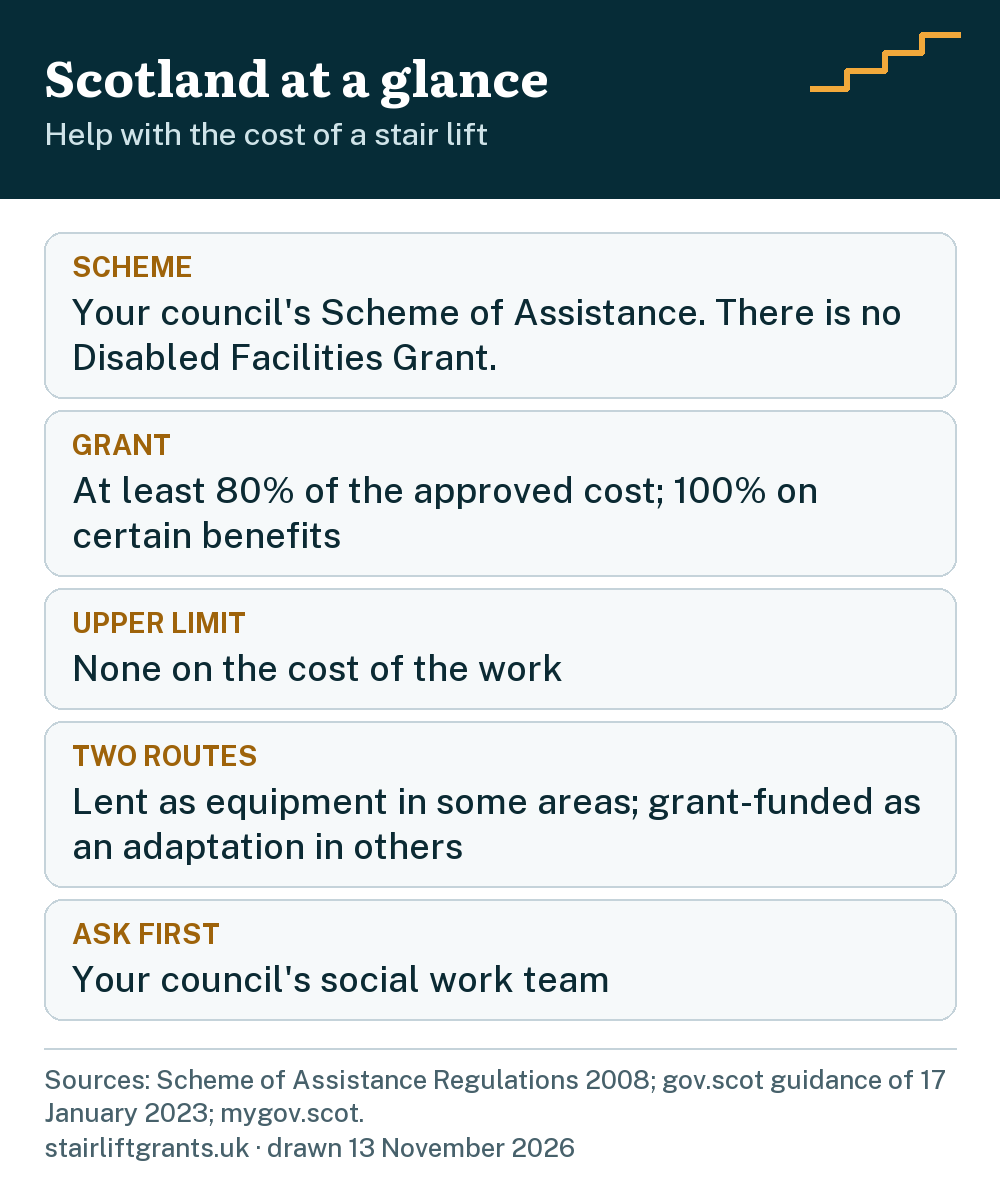
Stair lift help in Scotland at a glance
| Question | Answer | Source, checked 13 Nov 2026 |
|---|---|---|
| Is there a Disabled Facilities Grant? | No: "Disabled Facilities Grants are not available" | GOV.UK, what you'll get |
| What is there instead? | Your council's Scheme of Assistance, with a mandatory grant for essential adaptations | gov.scot leaflet for homeowners |
| How much? | At least 80% of the approved cost; 100% on five listed benefits | 2008 regulations (checked 12 Nov 2026) |
| Upper limit | None on the cost of the work, but the cost must be reasonable | gov.scot leaflet for homeowners |
| Means test | Not for the 80%. A council's top-up usually is | gov.scot leaflet for homeowners |
| Assessment | Required, usually by an occupational therapist | mygov.scot, how to apply |
| A stair lift specifically | Lent as equipment in some areas, grant-funded as an adaptation in others | gov.scot guidance, 2023 |
| Who to ask first | Your council's social work team | mygov.scot, how to apply |
The 80% and 100% rule
The Scottish Government's leaflet for homeowners puts it this way: "Your local authority must give you a grant for any changes that they deem essential. This is called 'mandatory grant'. The rules about mandatory grants apply to all Councils." Two levels follow.
- 80% for everyone. "This amount does not depend on your income." The council then advises you on ways to pay the rest.
- 100% on certain benefits. The grant meets the whole approved cost if the applicant, or someone in the household the rules count, gets one of these five benefits:
- Universal Credit
- Pension Credit (the guarantee credit part)
- Jobseeker's Allowance, where it is the income-based kind
- Employment and Support Allowance, where it is the income-related kind
- Income Support
The leaflet, which dates from 2011, lists four. The regulations were amended in 2013 to add Universal Credit, so the list above has five. Three more points come from the same leaflet. There is "no upper limit to the cost of the work", though the council checks that the cost is reasonable. Some councils "will 'top up' the 80% grant", and that extra "usually depends on your income". And the grant is for "significant changes to the structure of your home": small jobs such as grab rails, and movable equipment, are handled separately. Sources: gov.scot: funding adaptations to the home, a guide for homeowners (checked 13 Nov 2026); Housing (Scotland) Act 2006 (Scheme of Assistance) Regulations 2008 (checked 12 Nov 2026); Scottish regulations of 2013 adding Universal Credit to the list (checked 12 Nov 2026)
Equipment or adaptation: the two ways Scotland provides a stair lift
Here is the part no other nation has. Whether a stair lift counts as an adaptation, paid for by that grant, or as equipment, lent to you like a hoist or a shower chair, is not settled nationally. Scottish Government guidance from 2023 says so directly: there are "differences in the funding arrangements nationally, for items such as Stairlifts, with some services defining these as equipment, and providing them as part of their Community Equipment services, and other partnerships defining these as Adaptations and funding them from those budgets".
The same guidance gives a worked case. Glasgow City and West Dunbartonshire changed their arrangements in 2011 and 2012 "to remove the requirement for a grant application for the provision of Stairlifts to owner occupiers". Owners there are assessed in the same way as people in publicly funded housing and receive the stair lift through a shared equipment contract. The guidance lists what followed:
- "over a third of all stairlifts recycled back for use in other homes";
- "improved maintenance arrangements, as owners do not own the stairlifts, and are therefore no longer required to maintain these themselves".
So in an equipment area there may be no grant form and nothing for you to maintain, and the stair lift is collected when it is no longer needed. Ask whether there is any charge. In an adaptation area the 80% and 100% rule applies. Neither is better in every case, and you do not choose: your council's arrangements decide. The one question to ask at the start is "Does this area provide stair lifts as equipment or as an adaptation?" Sources: gov.scot: equipment and adaptations, guidance on provision (recycling) (checked 13 Nov 2026); gov.scot: equipment and adaptations, guidance on provision (adaptations and housing solutions) (checked 13 Nov 2026)
Who to ask first
mygov.scot's instruction is simple: "contact your local council's social work team. They will arrange a care needs assessment." A social care professional visits to talk about your situation, find out what help you need and explain what support they can offer. The gov.scot leaflet adds two things worth knowing before you ring:
- contact social work "even if you do not want to apply for a grant", because the assessment is how any help starts;
- "You must have an assessment if you want to apply for financial help. You will only receive a grant if the assessment concludes that a major adaptation is essential."
The assessment "will usually be carried out by an Occupational Therapist". Help varies by council: "Local authorities have their own local policies on the assistance they provide, so the help available will vary depending on where you live." Sources: mygov.scot: how to apply for care equipment or home adaptations (checked 13 Nov 2026); gov.scot: funding adaptations to the home, a guide for homeowners (checked 13 Nov 2026)
How long it takes, and when to order
England and Wales have a six-month legal limit on the council's decision. No equivalent national clock for Scotland was found in the regulations or guidance read for this page, so none is claimed. What the leaflet does say is candid: "If your case is assessed as a low priority you may have to wait some time for assistance. Limited budgets may also delay the provision of any grant."
Ask the council before you order anything
England's rule that starting work early can lose you the grant is written into GOV.UK's guide. This page found no Scottish source that states the same rule, and none that says the opposite. Until your council has told you in writing what it will pay for, do not order or sign for a stair lift.
If you rent your home in Scotland
The gov.scot leaflets for tenants say the arrangements differ by landlord. A private tenant can get the same mandatory grant, but "must seek your landlords consent before beginning any work"; the landlord "can withhold consent, but must have good reason to do so". A housing association "will make any essential changes to your home to meet your assessed needs" and will "organise and pay for these works, subject to the availability of funding". A council tenant is told the local authority "will make any essential changes to your home" and "organise and pay for these works". The full picture across the four nations is on a stair lift in a council house or rented home. Sources: gov.scot: funding adaptations to the home, a guide for private tenants (checked 13 Nov 2026); gov.scot: funding adaptations to the home, a guide for housing association tenants (checked 13 Nov 2026); gov.scot: funding adaptations to the home, a guide for local authority tenants (checked 13 Nov 2026)
VAT works the same in Scotland as in the rest of the UK, and is separate from any grant: see stairlift VAT relief. To compare Scotland with England, Wales and Northern Ireland, use the rules table, or answer five questions in the route checker.