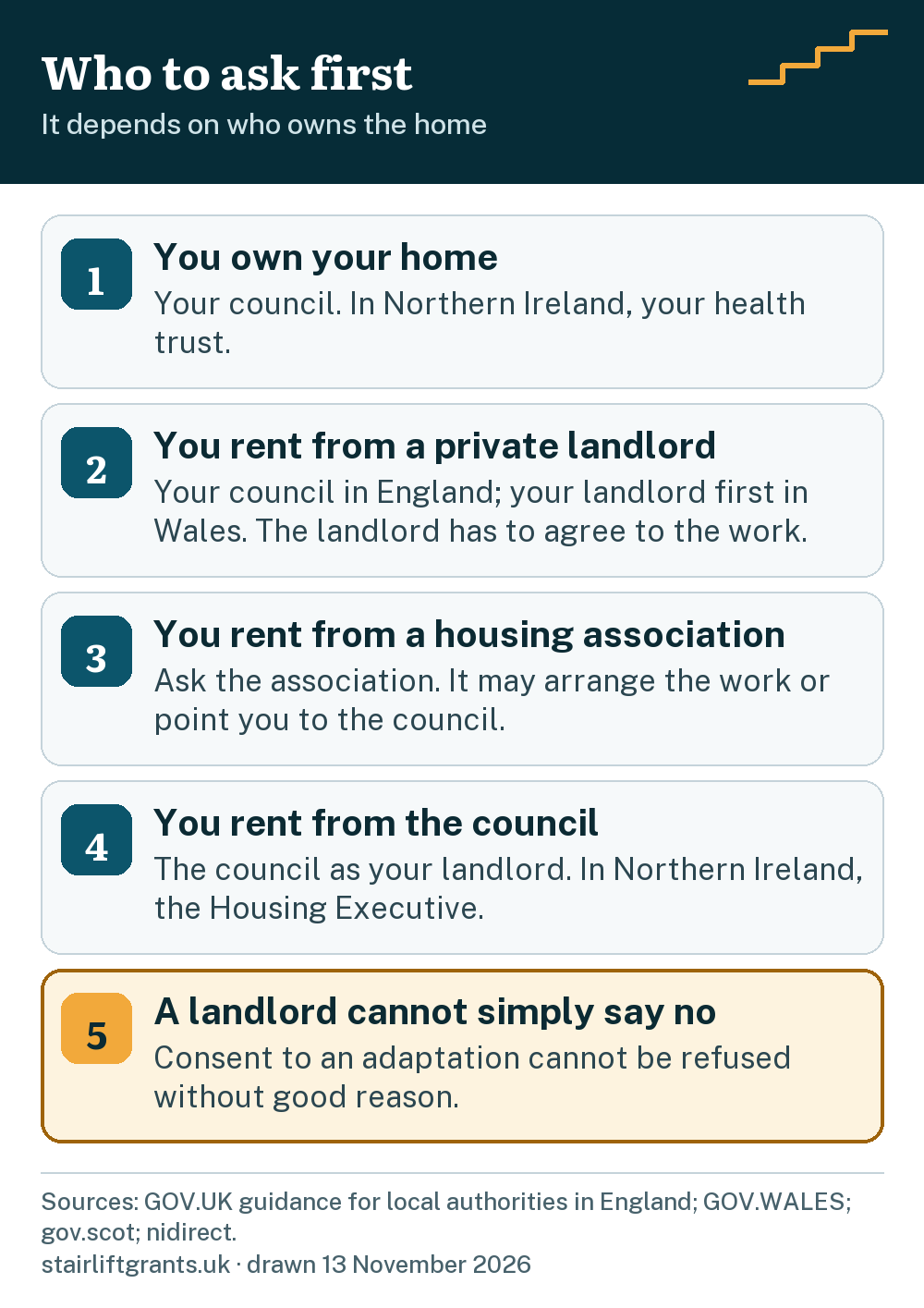
Owning or renting changes who you ask, who decides and who pays. A tenant still has every right to the help: GOV.UK says the person who applies for the grant can be the owner, a tenant or a landlord. What changes is the first step, and whether a grant is involved at all. Source: GOV.UK: Disabled Facilities Grants, eligibility (checked 13 Nov 2026)
If you rent from the council
In England, council tenants are not shut out of the grant. The guidance for councils says: "Eligible council tenants can apply for a DFG in the same way as any other applicant." But it goes on to say that councils with a housing revenue account "should self-fund home adaptations for council tenants through this account". In practice the council's housing team, as your landlord, is the place to start.
In Scotland the Scottish Government's leaflet for council tenants says the council's social work services assess your needs and the council "will make any essential changes to your home to meet your assessed needs. They will organise and pay for these works". In Wales the guide tells council tenants to contact their landlord. In Northern Ireland, Housing Executive tenants go to the Housing Executive as their landlord, which, nidirect says, "is responsible for doing certain major adaptations to tenants' homes". Sources: GOV.UK: Disabled Facilities Grant delivery, guidance for local authorities in England (checked 13 Nov 2026); gov.scot: funding adaptations to the home, a guide for local authority tenants (checked 13 Nov 2026); GOV.WALES: adapt your home, how to apply (checked 13 Nov 2026); nidirect: adapting your home (checked 13 Nov 2026); nidirect: adaptations in Housing Executive property (checked 13 Nov 2026)
If you rent from a housing association
- England: housing association tenants can apply for the grant. The guidance said in 2022 that they made up "around 22% of all grants approved", and it asks councils and associations to agree contributions and timescales between them. The association, as landlord, has to agree to the work.
- Wales: the Welsh Government's Physical Adaptations Grant is "available through your housing association", and its list includes "providing stair lifts or through floor lifts". The association applies for the funding. Stock transfer associations are excluded.
- Scotland: "Your housing association will make any essential changes to your home to meet your assessed needs. They will organise and pay for these works, subject to the availability of funding."
- Northern Ireland: major adaptations need an occupational therapist's assessment, after which the therapist "will send recommendations to your social landlord", which arranges the agreed work.
Sources: GOV.UK: Disabled Facilities Grant delivery, guidance for local authorities in England (checked 13 Nov 2026); GOV.WALES: adapt your home if you live in social housing (checked 13 Nov 2026); gov.scot: funding adaptations to the home, a guide for housing association tenants (checked 13 Nov 2026); nidirect: adapting your home (checked 13 Nov 2026)
If you rent from a private landlord
Private tenants have the most paperwork, because the work is to someone else's property. In England a tenant applies to the council with a tenant's certificate, and the guidance says the application "should also be accompanied by an owner's certificate signed by the landlord", unless the council thinks that unreasonable. A grant "cannot normally be awarded without the landlord's permission to carry out the works".
The law limits what a landlord can do with that permission. The guidance says: "Under the Equality Act 2010 a landlord cannot unreasonably withhold their consent to an adaptation or attach unreasonable conditions to any consent." Where consent is refused, "the burden is on the landlord to show that their consent has not been unreasonably withheld", and if it was unreasonably withheld "it must be taken that consent has been given". Source: GOV.UK: Disabled Facilities Grant delivery, guidance for local authorities in England (checked 13 Nov 2026)
Elsewhere: in Wales a private tenant should contact the landlord first. In Scotland a private tenant can get the same mandatory grant as an owner but "must seek your landlords consent before beginning any work"; the landlord "can withhold consent, but must have good reason to do so", and can set conditions, "such as asking to comment on plans or removing the adaptation when you move out". In Northern Ireland private tenants can get the Housing Executive's grant like owners. Sources: GOV.WALES: adapt your home, how to apply (checked 13 Nov 2026); gov.scot: funding adaptations to the home, a guide for private tenants (checked 13 Nov 2026); nidirect: Disabled Facilities Grants (checked 13 Nov 2026)
If you are the landlord
A landlord can apply for the grant for a disabled tenant, and GOV.UK says "landlords can get a grant without their income and savings being taken into account". In return "the council may ask for the property to be let to another disabled person if the current tenant moves within 5 years". The guidance for councils goes as far as encouraging councils to promote landlord applications "for the majority of cases", because they remove the means test and show the landlord's consent.
For a tenant, asking the landlord to apply can therefore be the quickest route in England. In Northern Ireland landlords are also named among those who can get help. Sources: GOV.UK: Disabled Facilities Grants, what you'll get (checked 13 Nov 2026); GOV.UK: Disabled Facilities Grant delivery, guidance for local authorities in England (checked 13 Nov 2026); nidirect: Disabled Facilities Grants (checked 13 Nov 2026)
The route by tenure, nation by nation
| Tenure | England | Wales | Scotland | Northern Ireland |
|---|---|---|---|---|
| Own the home | Council: grant | Local authority: grant | Council social work: grant or equipment | Health trust, then the Housing Executive: grant |
| Council tenant | Council as landlord | Landlord | Council arranges and pays | Housing Executive as landlord |
| Housing association | Council grant, with the association's consent | Association: Physical Adaptations Grant | Association arranges and pays | Landlord, on the therapist's recommendation |
| Private tenant | Council grant, with the landlord's consent | Landlord first | Council grant, with the landlord's consent | Health trust, then the Housing Executive: grant |
Sources as listed at the foot of this page, checked 13 Nov 2026.
Whatever the tenure, two things hold everywhere. An assessment comes first, and nothing should be ordered until the body paying for it has agreed in writing. If you own the home, the rest of this site applies to you directly: start with council grants for stairlifts, or answer five questions in the route checker.